Steering assist gear: plastic worm wheel (VDI 2736-3)
An electric power steering adds the motor’s torque through a reduction. On the column it is usually a steel worm on the motor driving a plastic wheel, which runs quietly and needs no oil. The gear must carry the assist and let the road drive it back, so that the steering wheel returns to the centre when the driver lets go.
Axomek rates the plastic worm wheel after VDI 2736-3 on the project’s shafts and bearings: the load value, the tooth root and the flank, the efficiency with the motor driving and driven back, and self-locking. In a whole steering system the same worm is one stage of the assist’s path to the rack.
- VDI 2736-3:2014
- VDI 2736-2
What Axomek calculates
You enter
- Starts, wheel teeth, axial module, diameter quotient, wheel helix angle, pressure angle, face width and the wheel’s profile shift
- The wheel’s plastic (POM, PA 66, PA 46, PEEK or your own), its bulk temperature, lubrication (grease, oil or dry) and the expected flank wear
- The wheel torque or, mounted on shafts, the motor’s torque from the train, the worm speed, the application factor and the life
- The worm and wheel shafts with their bearings, and the bearings’ efficiencies
- Optional minimums for the load value safety and the back-drive efficiency
It calculates
- Load value against and its safety
- Tooth root shear against its limit and the root safety
- Mean flank pressure with its contact ellipse, and the flank safety where there is data to compare it with
- Mesh and overall efficiency with the motor driving and driven back, self-locking, the mesh forces and the worm torque
- The shafts and their bearings at the gear’s forces, torque and speed
Method and standards
- VDI 2736-3:2014 for a steel cylindrical worm with 1–5 starts on a helical plastic wheel at 90°: the load value against Figure 4, the root against the shear limit from Figures 6–9 at the wheel temperature and cycles
- The flank pressure compared with the limit of a comparable cylindrical gear from VDI 2736-2 data where there is one; without suitable data the flank is not rated
- Efficiency both ways from the lead angle and the friction angle, the bearings’ efficiencies multiplied in; a self-locking worm has no back-drive efficiency
- Validated against the two worked examples of VDI 2736-3 Annex A
Limits
- No wear prediction for the plastic wheel: give the expected flank wear. No temperature calculation: give the wheel’s bulk temperature, measured or estimated.
- The flank limit borrowed from cylindrical gears is an estimate, and VDI 2736-3 notes that its safeties come out low; an enveloping (throated) plastic wheel is refused.
- Figure 4 holds for about 10⁵–10⁶ wheel load cycles at 1–8 m/s: beyond 10⁶ cycles or 8 m/s a passing is not determined, below them it is marked indicative.
- The flank is rated from the lowest wheel temperature up to the bulk temperature, since a cooler plastic wheel is stiffer and takes a higher flank pressure; the data start at 20 °C, so a colder start leaves the flank not determined.
- The column EPS template is the assist gear alone, not a whole steering: no column, rack or steering system. The Dual-pinion EPS template has a plastic worm in a whole steering.
- The template’s minimum load value safety 1.0 and back-drive efficiency 0.4 are template values, not standard values.
What its module is validated against, and what not: the verification and validation manual, Worm gears: DIN 3996, ISO/TR 14521 and VDI 2736-3
Worked example
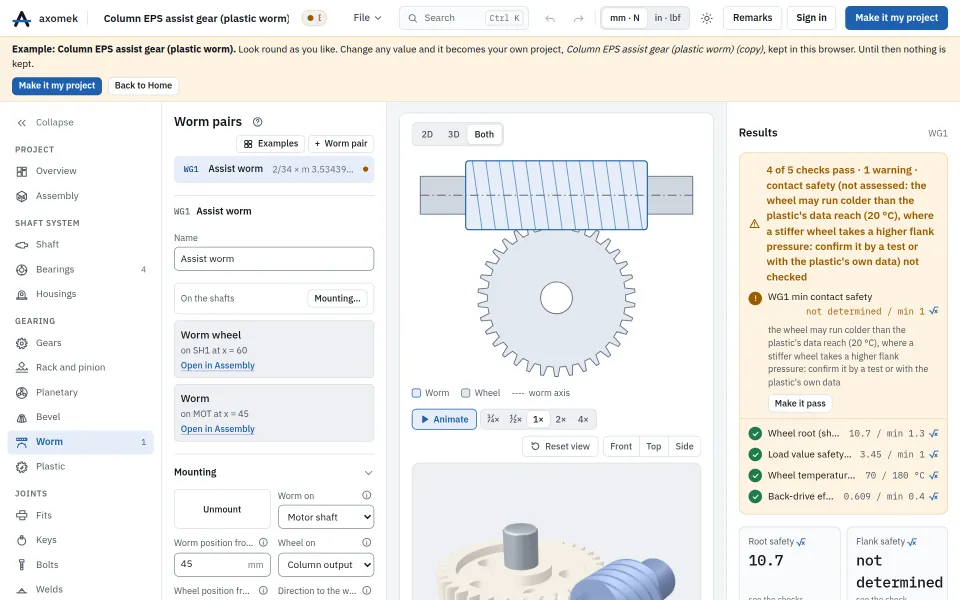
The column EPS assist gear template: a two-start steel worm on the motor driving a greased 34-tooth PA 66 wheel of module 3.5 mm on the column output shaft, 17:1, the motor giving 2.72 N·m at 1000 rpm, the wheel at 70 °C for 45 hours of full assist and down to a −40 °C start, both shafts on catalogue ball bearings.
| Result | Value |
|---|---|
| Wheel torque from the motor | 33.1 N·m |
| Load value | 1.76 |
| Its limit | 6.08 |
| Load value safety (min 1.0) | 3.453 |
| Root safety (min 1.3) | 10.70 |
| Mean flank pressure | 28.0 MPa |
| Flank safety from 20 °C (min 1.0) | 1.64 |
| Overall efficiency, motor driving | 71.6 % |
| Back-drive efficiency (min 40 %) | 60.9 % |
Nothing fails. One check is not determined because the method’s data run out: the flank passes from 20 °C up, but the data end at 20 °C, short of the −40 °C start. The load value lies within Figure 4 of VDI 2736-3 at the wheel’s load cycles.
The numbers come from the engine: the same commands, run with the axomek command line, give them.
The same with the axomek command line
axomek new ex.axomek --template column-eps
axomek solve ex.axomek --jsonQuestions
Why must the assist gear run backwards well?
When the driver lets go after a turn, the tyres drive the rack back to the centre through the assist gear. A self-locking worm would hold the steering wheel where it is, so the rating gives the back-drive efficiency, and a minimum for it can be a check.