Worm gear calculation (DIN 3996)
A worm drive gives a high ratio in one stage, at the cost of high sliding between worm and wheel. It is therefore usually limited by wear and heat rather than by tooth breakage, and DIN 3996 rates it on those terms: friction and efficiency, wear of the bronze wheel over its life, pitting, the root of the worn tooth, the worm’s deflection and the oil sump temperature.
Axomek rates cylindrical worm pairs with axes crossing at 90°, a hardened steel worm driving a bronze or cast iron wheel, by DIN 3996:2012 method C, and gives every loss alongside the five safeties.
- DIN 3996:2012
What Axomek calculates
You enter
- Worm starts, wheel teeth, axial module mx, diameter quotient q, wheel profile shift, face width, generating angle and flank form (A, N, K, I or C)
- Wheel torque in N·m, application factor KA, worm speed in rpm, life in h and starts per hour
- Lubricant (mineral, polyalphaolefin or polyglycol), dip or injection lubrication and the viscosity at 40 °C and 100 °C
- Wheel material (bronzes CuSn12-C-GZ, CuSn12Ni2-C-GZ and -GC, CuAl10Fe5Ni5-C-GZ, or cast iron EN-GJS-400-15 and EN-GJL-250), the permissible wear and the accepted loss of wheel quality
- Worm bearing span, bearing arrangement and seals for the deflection and losses
- Cooling: a heat balance of the housing surface, or the method C relation for a ribbed housing with or without a fan
It calculates
- Geometry: centre distance, ratio, mean diameters and lead angle
- Mesh and overall efficiency, back-driving and starting efficiency, and whether the pair is self-locking
- Losses of the mesh, idling, bearings and seals
- Mean flank pressure and pitting safety SH
- Wear depth over the life against the permissible wear, wear safety SW and wear life
- Shear stress of the worn tooth root and root safety SF
- Worm deflection, oil sump temperature and temperature safety ST
Method and standards
- DIN 3996:2012-09 method C, with the characteristic values p*m, h* and s* from the standard’s equations or given from a method B analysis
- Mean friction μzm from the reference gear’s base value and the size, geometry, material and roughness factors (7.4); losses and efficiency (7)
- Wear from the lubricant film at the wheel bulk temperature and the wear intensity by material and oil (8)
- Pitting (9), worm deflection (10) and the root of the worn tooth (11)
- Oil sump temperature (12) and wheel bulk temperature (13)
- The rating reproduces the standard’s three worked examples (
axm verify)
Limits
- No scuffing check.
- The worm shaft’s strength and its bearings’ life are not rated here; rate them in the shaft and bearings modules.
- The pair is not mounted on the project’s shafts.
- The method C sump temperature holds for a ribbed cast iron housing with centre distances of 63–400 mm, worm speeds of 60–3000 rpm and ratios of 10–40.
Worked example
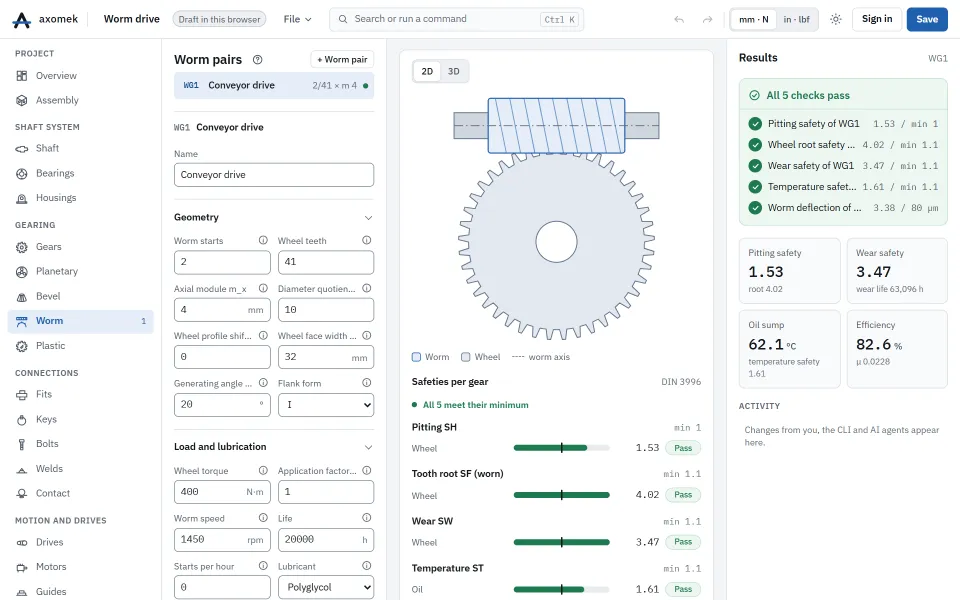
The worm drive template: two starts, 41 teeth, mx 4 mm, q 10, b2H 32 mm, 400 N·m output at 1450 rpm, a CuSn12Ni2-C-GZ wheel on polyglycol with dip lubrication, and a ribbed housing with a fan on the worm shaft.
| Result | Value |
|---|---|
| Overall efficiency | 82.6 % |
| Power loss | 625 W |
| Pitting safety SH (min 1.0) | 1.535 |
| Wear depth after the life | 0.339 mm |
| Wear safety SW (min 1.1) | 3.47 |
| Root safety SF of the worn tooth (min 1.1) | 4.02 |
| Oil sump temperature | 62.1 °C |
| Temperature safety ST (min 1.1) | 1.611 |
All checks pass; the pitting and temperature safeties are the closest to their minimums.
The numbers come from the engine: the same commands, run with the axm command line, give them.
The same with the axm command line
axm new ex.axm.json --template worm-drive
axm solve ex.axm.json --jsonQuestions
Why does the oil matter so much in a worm drive?
The base oil changes the friction and the wear markedly. On mineral oil instead of polyglycol the template’s wheel wears so much that the wear check fails, and the sump runs hotter against a lower limit.