Gear calculation (ISO 6336)
ISO 6336 rates cylindrical involute gears against the two fatigue failures that end most gearboxes: pitting of the flanks, driven by the contact stress, and breakage of the tooth root, driven by the bending stress in the fillet. Each starts from a nominal stress, raises it by load factors for shocks, dynamics and uneven load, and compares it with the strength of the material corrected for the actual gear.
Axomek rates external and internal spur and helical pairs generated by a basic rack. It gives the involute geometry with profile shift, the load factors, the pitting and root safety of pinion and wheel and, when you ask for it, scuffing, a load spectrum and a loaded tooth contact with flank modifications. Mounted on two shafts, the pair loads both shafts and their bearings with its tooth forces; the two-stage helical gearbox example shows such a gearbox whole, its three shafts set round each other by the mesh angles in the assembly view, coloured by their checks.
- ISO 6336-1:2006
- ISO 6336-2:2019
- ISO 6336-3:2019
- ISO 6336-5:2016
- ISO 6336-6
- ISO/TS 6336-20:2022
- ISO/TR 13989-2:2000
- ISO/TR 14179-1
What Axomek calculates
You enter
- Tooth numbers, normal module, face width, pressure angle, helix angle and profile shifts; internal (ring) wheels with their shaper cutter
- Pinion torque in N·m, speed in rpm, application factor KA, ISO 1328 grade and required life in h
- Face load factor KHβ, or the pinion shaft layout for method C (bearing span, offset, shaft diameter, constant K′)
- Materials with σHlim and σFlim from ISO 6336-5:2016, oil viscosity and flank and fillet roughness
- Rim thickness, tip relief, rack dedendum and root radius, and the edition of ISO 6336-2/-3 (2019 or 2006)
- Optional: scuffing (oil temperature, FZG load stage, lubrication), a load spectrum, flank modifications and misalignment
- Minimum safeties SH, SF, SintS and SB
It calculates
- Geometry: centre distance, working pressure angle, diameters and contact ratios
- Load factors Kv, KHβ, KFβ, KHα and the Z and Y factors
- Contact stress σH and pitting safety SH of pinion and wheel
- Tooth root stress σF and root safety SF of pinion and wheel
- Scuffing safeties SB (flash temperature) and SintS (integral temperature)
- Tooth forces on the shafts, mesh loss and efficiency
- Safeties over a load spectrum with the damage sums, and the loaded tooth contact with transmission error
Method and standards
- ISO 6336-1:2006: Kv by method B from the resonance ratio, KHβ by method C from the shaft layout or as given, KHα by method B
- ISO 6336-2 method B: σH = ZB (or ZD)·σH0·√(KA·Kv·KHβ·KHα), with ZNT, ZL, Zv, ZR and ZW in the permissible stress
- ISO 6336-3 method B: the root stress with the load at the outer point of single pair contact, YF, YS, Yβ, YB and YDT
- The 2019 edition of parts 2 and 3 by default, or the 2006 edition as ISO/TR 6336-30 uses; the 2006 rating is checked against the eight worked examples of ISO/TR 6336-30:2017
- Load spectra by ISO 6336-6 with Palmgren–Miner, each bin at KA = 1
- Scuffing by the flash temperature of ISO/TS 6336-20:2022 (Annex A) and the integral temperature of ISO/TR 13989-2:2000; mesh loss by ISO/TR 14179-1
Limits
- Micropitting (ISO/TS 6336-22), tooth flank fracture (ISO/TS 6336-4) and wear are not rated.
- The size factor ZX is taken as 1.
- No-load losses (churning, windage) are not part of the mesh loss.
- In a gearbox the mesh misalignment from shaft and housing deflection is not fed into KHβ automatically; enter it as a misalignment or through the shaft layout.
- The loaded tooth contact leaves out bending coupling between slices, edge effects and dynamics.
Worked example
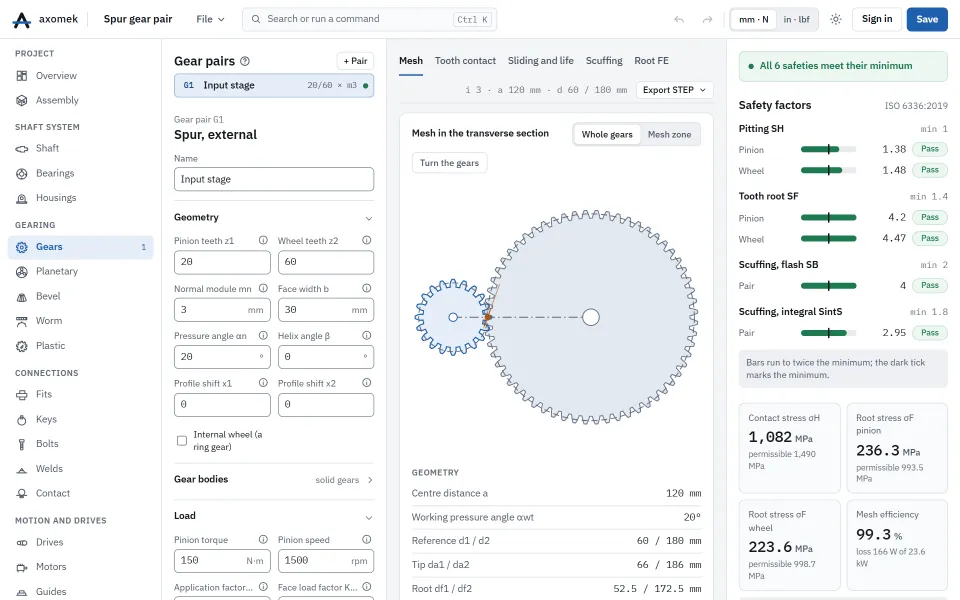
The spur gear pair template: 20/60 teeth, mn 3 mm, b 30 mm, 150 N·m at 1500 rpm, KA 1.25, KHβ 1.2, case-hardened 18CrNiMo7-6 for 20 000 h, with a scuffing check added at 70 °C oil and FZG stage 10.
| Result | Value |
|---|---|
| Contact stress σH, pinion | 1,082 MPa |
| Pitting safety SH, pinion (min 1.0) | 1.377 |
| Pitting safety SH, wheel | 1.484 |
| Root stress σF, pinion | 236.3 MPa |
| Tooth root safety SF, pinion (min 1.4) | 4.205 |
| Tooth root safety SF, wheel | 4.467 |
| Scuffing safety SB, flash temperature (min 2.0) | 3.995 |
| Scuffing safety SintS, integral temperature (min 1.8) | 2.952 |
All checks pass. Pitting of the pinion is the closest; the tooth root and scuffing have wide margins.
The numbers come from the engine: the same commands, run with the axm command line, give them.
The same with the axm command line
axm new ex.axm.json --template gear-pair
axm gear update ex.axm.json G1 --patch {"scuffing":{"oilTemperature":70,"fzgStage":10}}
axm solve ex.axm.json --jsonQuestions
Which edition of ISO 6336 is used?
ISO 6336-1 in its 2006 edition, and parts 2 and 3 in the 2019 edition by default. You can switch parts 2 and 3 to the 2006 edition, the one the worked examples of ISO/TR 6336-30 use.
What minimum safeties should I use?
ISO 6336 leaves them to the user. The defaults are SHmin 1.0 and SFmin 1.4: a root breakage usually ends the gearbox, while initial pitting may be tolerable. Because σH grows with the square root of the load, SH = 1.2 means only 1.44 times the load to the pitting limit.