Plastic gear calculation (VDI 2736)
Thermoplastic gears lose stiffness and strength quickly as they warm up, so their rating has to start from the temperature of the teeth. VDI 2736 Part 2 estimates the flank and root temperatures from the friction heat and the cooling, then checks the root and the flank with the strength at those temperatures, and adds the wear and the deformation of the tooth tip.
Axomek rates spur and helical pairs in which at least one gear is plastic, against steel or plastic, dry, greased or oiled. The geometry is that of the ISO 6336 gear pair, generated by the basic rack.
- VDI 2736-2
What Axomek calculates
You enter
- Tooth numbers, normal module, face width, pressure angle, helix angle and profile shifts
- Materials of pinion and wheel: POM, PA66, PA66 GF30, PEEK (typical values) or steel, or your own data by temperature
- Pinion torque in N·m, speed in rpm, application factor KA and life in h
- Lubrication (dry, greased or oil) and the friction coefficient
- Housing (open, partly open or closed, with its surface), ambient temperature and relative duty
- Minimum root and flank safety, maximum wear and maximum tip deformation
It calculates
- Flank and root temperature of each plastic gear against the material’s limit
- Root stress and root safety SF with the strength at the root temperature and the load cycles
- Flank stress and flank safety SH for lubricated gears
- Wear depth over the life
- Tooth tip deformation against 0.07·mn
Method and standards
- Loss factor HV of the mesh by the Ohlendorf relation
- Flank and root temperatures from the friction power P·μ·HV, the heat transfer of the teeth and the housing, and the duty (VDI 2736-2)
- Root stress with the load at the tip and the form factors of ISO 6336-3, against the root strength at temperature
- Flank stress with ZE from the moduli at the flank temperatures, for lubricated pairs
- Wear from the friction work along the flank and the wear coefficient; tip deformation from the moduli at the root temperatures
Limits
- The built-in material table holds typical values, not the values of VDI 2736 and not any maker’s; enter the maker’s data for the grade before relying on a result.
- Moisture uptake (and its effect on PA) and creep under long standstill loads are not modelled.
- A steel gear in the pair is not rated here; rate it as a steel gear pair if it matters.
- A dry pair gets no flank safety: wear governs.
- The pair is not mounted on the project’s shafts.
Worked example
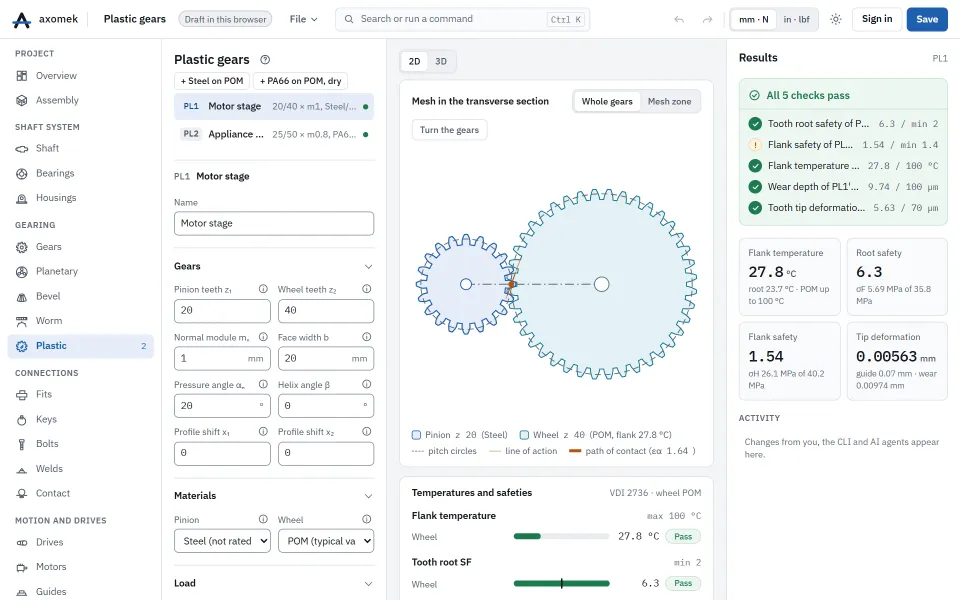
The plastic gears template’s motor stage: a 20-tooth steel pinion on a 40-tooth POM wheel, mn 1 mm, b 20 mm, greased, 0.4 N·m at 1000 rpm for 2000 h in an open housing at 23 °C. The template’s second pair, a dry PA66 pinion on a POM wheel, is not shown here.
| Result | Value |
|---|---|
| Flank temperature of the POM wheel | 27.8 °C |
| Temperature limit of POM | 100 °C |
| Root stress of the wheel | 5.69 MPa |
| Root safety SF (min 2) | 6.30 |
| Flank safety SH (min 1.4) | 1.540 |
| Wear of the wheel (max 100 µm) | 9.7 µm |
| Tip deformation | 5.6 µm |
| Permissible tip deformation | 70 µm |
All checks pass; the flank safety of the greased POM wheel is the closest to its minimum.
The numbers come from the engine: the same commands, run with the axm command line, give them.
The same with the axm command line
axm new ex.axm.json --template plastic-gears
axm solve ex.axm.json --jsonQuestions
Are the material values those of VDI 2736?
No. The table of POM, PA66, PA66 GF30 and PEEK holds typical values for first sizing. Enter the maker’s data for the grade you will mould as own material data.