Belt and chain drive calculation
A belt or chain drive steps speed and torque between two shafts, and its strand pull loads both shafts and their bearings. How large that load is, and where it points, depends on the pretension: too little and a friction belt slips, too much and the bearings carry more than they need to.
Axomek computes the strand tensions by the Euler–Eytelwein relation with centrifugal tension, checks the pretension against slip, and puts the shaft load on both shafts of the project, so the shafts and bearings are rated with it.
What Axomek calculates
You enter
- Kind: V-belt, flat belt, timing belt or roller chain, with its typical efficiency or your own
- Driver torque in N·m, speed in rpm, driver rotation and the direction to the driven shaft
- Centre distance, friction coefficient and groove angle (V-belts)
- Belt or chain mass per metre and the pretension at standstill (empty: the least that does not slip)
- Pitch and teeth for chains and timing belts
- For each pulley: the shaft, position, pitch diameter and mass
It calculates
- Ratio, driven torque and speed
- Effective force, wrap angle, tight and slack strand tension and the friction limit eμ′β
- Least pretension and the slip check (slack strand check for timing belts)
- Shaft load and its direction on both shafts
- Belt speed, centrifugal tension, power and loss
- Speed variation from the polygon effect of a chain
Method and standards
- Effective force Ft = 2T/d1, strand angle γ = asin((d2 − d1)/2a) and wrap angle β = 180° − 2|γ|
- Friction limit (F1 − Fc)/(F2 − Fc) ≤ eμ′β with μ′ = μ/sin(φ/2) for V-belts, and centrifugal tension Fc = q·v²
- Fixed centres: F1 = F0 + Ft/2, F2 = F0 − Ft/2, and the least pretension that does not slip
- Shaft load as the vector sum of F1 − Fc and F2 − Fc along the strands (the centrifugal tension does not load the shafts), off the centre line towards the tight strand
- Alternatively a tension factor model, k·Ft along the centre line
Limits
- No belt or chain standard is applied: the belt section, number of belts, power ratings, belt or chain life, chain wear, tooth jump and sprocket strength are not assessed.
- The centre distance is fixed; tensioners and idlers are not modelled.
- The efficiency is a constant per kind, not computed from the load.
- An empty pretension means the drive runs exactly at the slip limit; enter the pretension you will set at assembly for a real design.
Worked example
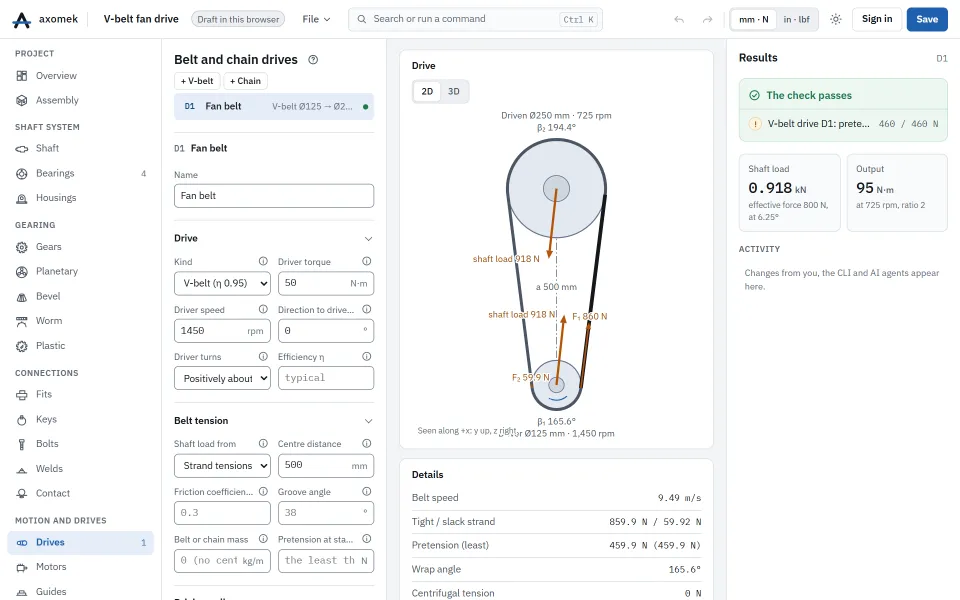
The V-belt fan drive template: a motor shaft drives a fan shaft through a V-belt from Ø125 mm to Ø250 mm, 50 N·m at 1450 rpm, centre distance 500 mm, with the least pretension and no belt mass.
| Result | Value |
|---|---|
| Effective force Ft | 800 N |
| Wrap angle on the small pulley | 165.6° |
| Tight strand F1 | 859.9 N |
| Slack strand F2 | 59.92 N |
| Least pretension F0,min | 459.9 N |
| Shaft load | 918.1 N |
| Shaft load direction, about +x from +y | 6.25° |
| Driven torque | 95 N·m |
With no pretension entered the drive runs at the least pretension, so the slip check passes at exactly 100 %; enter the pretension you will set at assembly for a real margin.
The numbers come from the engine: the same commands, run with the axm command line, give them.
The same with the axm command line
axm new ex.axm.json --template belt-drive
axm solve ex.axm.json --jsonQuestions
Why is the shaft load lower than 2·Ft?
At the least pretension the strand model gives the load the belt really needs to transmit Ft without slipping. The tension factor model (k·Ft, k 2 for V-belts) is a rule of thumb that covers a typical assembly pretension; on the template it gives about 1.7 times the strand model’s load.