Bearings
Rolling bearings on their own or on a shaft support: load distribution, contact stress, ISO 281 rating life, static safety, lubricant film, friction, thermal speeds and stiffness.
- ISO 281:2007
- ISO 76:2006
- ISO/TS 16281:2008
- ISO/TR 1281-1:2008
- DIN ISO 15312:2004
- DIN 732:2010
What it is for
The Bearings module solves the inner ring's equilibrium against every rolling element, so you get each element's load, the Hertz contact stress, the life from the element loads (ISO/TS 16281), the static safety and the lubricant film. A bearing can stand on its own with loads you enter, or sit on a shaft support so the shaft loads it. The bearing-6207 template is a 6207 deep groove ball bearing under Fy = 2 500 N and Fx = 800 N at 2 900 rpm and 70 °C; its numbers appear below.
Adding a bearing
+ Bearing opens the catalogue search ("Search the catalogue, e.g. 6310, 7212 B, NU 3"): a few common bearings, the series 60, 62, 63, 72 B, 73 B, NU 2 and NU 3 for bore codes 00–20, the tapered series 302 and the spherical series 222, with ISO 15 boundary dimensions, and the matched pairs 7207b-db and 30207-db.
A preset's internal geometry is estimated ("Internal geometry is estimated from the preset"). C0 comes out close to bearing makers' catalogues; C is an ISO 281 rating, and makers often publish 10–25 % more. For exact ratings, enter the maker's internal geometry and click Mark as exact.
Import CSV reads your own catalogue: header designation,type,d,D,B,C, optionally C0, contactAngle, elementDiameter, elementCount, pitchDiameter, rollerLength, also written with spaces or underscores (contact angle, pitch_diameter). Without the geometry, the element diameter is fitted so that the ISO 281 rating equals your C. Other columns, such as a mass, are not read; the message after the import names them, so a misspelt column does not go unnoticed.
The 14 bearing types
| No. | Type | Notes |
|---|---|---|
| 1 | Deep groove ball bearing | Radial and axial loads |
| 2 | Double row deep groove ball bearing | |
| 3 | Angular contact ball bearing | Pairs: O, X, tandem |
| 4 | Double row angular contact ball bearing | |
| 5 | Self-aligning ball bearing | No moment, no tilt stiffness |
| 6 | Four-point contact ball bearing | |
| 7 | Thrust ball bearing | Axial only |
| 8 | Angular contact thrust ball bearing | |
| 9 | Cylindrical roller bearing | NU/N; NJ, NUP, NF with ribs |
| 10 | Double row cylindrical roller bearing | As type 9 |
| 11 | Needle roller bearing | |
| 12 | Cylindrical roller thrust bearing | On its own only, not on a shaft support |
| 13 | Tapered roller bearing | Pairs: O, X, tandem |
| 14 | Spherical roller bearing | No moment, no tilt stiffness |
Held square, a single angular contact ball bearing or tapered roller bearing needs an axial load of at least . Give it that load, model a pair, or put two bearings on a shaft. An NU or N cylindrical roller bearing takes no axial load. Tick "Ribs on both rings (NJ, NUP, NF)" and choose the Rib design: an NUP holds Fx both ways, an NJ or NF one way only.
Inputs
The inspector shows these sections in this order.
Type and geometry
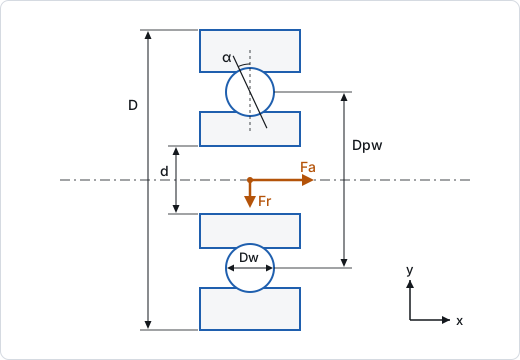
- Pitch diameter, Element diameter, Number of elements, Roller length (rollers) and Contact angle.
- Inner conformity and Outer conformity (balls): groove radius over ball diameter, typically 0.52 and 0.53. The rating factor fc is calculated at these radii.
- Radial clearance (unmounted) and, for balls and tapered rollers, Axial clearance.
- Arrangement for types 3 and 13: "Pair, back-to-back (O)", "Pair, face-to-face (X)" or "Pair, tandem", with Pair spacing and, for O and X, Preload (N). The ratings and life are then the pair's.
- Row distance for double-row bearings, Ball density (7 850 kg/m³ for steel, 3 200 for silicon nitride).
- "High-speed model: ball centrifugal forces (spindles)" balances every ball against its centrifugal force and gyroscopic moment.
- "Elastic outer ring in its housing" lets a wall or imported-mesh housing deform the outer raceway.
Mounting and fits
For deep groove ball and radial roller bearings, Add mounting turns the unmounted clearance into an operating clearance. Enter the Bore d and Outside diameter D, the Shaft fit and Housing fit (for example k5 and H7), the Inner ring temperature and Outer ring temperature, the Interference used (Smallest, Mean, Largest) and the Housing material. "Seat details" add a hollow shaft bore, the housing's outside diameter, direct interferences, seat roughness Rz and moduli. A negative operating clearance means the bearing runs preloaded. See Fits.
Operating conditions
Set Speed (rpm) and Temperature (°C), or tick "Compute the temperature from a heat balance" and enter Ambient, Heat transfer, Oil flow and Oil inlet. Choose Inner ring rotates or Outer ring rotates.
Loads
A bearing on its own takes Radial force Fy, Radial force Fz, Axial force Fx (N) and Moment My, Moment Mz (N·mm). Inner ring tilt is "Held at zero, as ISO 281 rates (no moment load)" by default. The moment that holds the ring square is reported (−15 614 N·mm about z in the template). With "Free to tilt under the moments", a single-row bearing under a combined load tilts away from its load zone. In the template, the modified life then drops from 223 847 h to 63 092 h, and s0 drops from 7.669 to 5.761.
To load a bearing from a shaft, open the Shaft module, select a support and choose the bearing in its Bearing list (or a "New bearing" preset). The Loads section then says "Loaded by shaft support B1. Loads update as the shaft changes." and offers Unlink. On a shaft, the ring always takes its tilt from the shaft's slope.
Lubrication
Lubrication and cleanliness sets the contamination level for eC, from "Oil with on-line filter, ISO 4406 -/13/10" to "Grease, very severe contamination". Enter Viscosity at 40 °C and Viscosity at 100 °C (mm²/s). Viscosity at operating temperature (for κ) uses the Walther curve (ASTM D341) by default. Method (for friction) is "Grease or oil mist", "Oil bath" or "Oil jet or vertical shaft". Friction model is Palmgren or the four-component model; both are always reported. "Film details" holds the pressure–viscosity coefficient, the surface roughness, an oil supply layer and the seal friction.
Materials, Requirements and Calculation
- Materials: hardness (HRC) and moduli; new bearings are steel, 207 000 MPa, ν = 0.3.
- Requirements: Reliability (L10 to L0.05, 90 % to 99.95 %, by a1 of ISO 281), Minimum life (h), Minimum static safety s₀, Case depth (case-hardened) and Permissible temperature (nθ). Typical life targets are 20 000–30 000 h for machine tools and 40 000–60 000 h for pumps and fans. A typical static safety is s0 ≥ 1–2 for normal service.
- Calculation: for rollers, Lamina per roller, Edge stress, Life factor aISO and Crowning k; for all types, Minimum load factor kr and Element offset.
Duty cycle
Machines rarely run at one load. In the Duty cycle card, Add a duty cycle starts with three cases: Full load 30 %, Part load 60 % at ×0.6 and Idle 10 % at ×0. Each case has a share, a load factor and, optionally, a speed and a temperature (Add load case for more). The combined life is (Palmgren–Miner), and static safety uses the worst case. In the template, with the part load at 1 450 rpm, the combined life is 642 297 h, and the full-load case causes 86.1 % of the damage. A case at 0 rpm is a standstill: it is checked statically and collects no revolutions.
Results
The results panel starts with the modified rating life, s₀ and the maximum contact stress, followed by "What drives life", Requirements, Film and friction, Maintenance, Ratings and factors, Speeds and Inner ring displacement. The centre holds the element load and contact stress charts and the Subsurface stress, Stiffness, Roller profile and Duty cycle cards. The bearing-6207 template gives:
| Result | Value |
|---|---|
| Modified rating life L10m / basic L10 | 223 847 h / 6 061 h |
| Life factor aISO, viscosity ratio κ, eC | 36.9, 2.36, 0.82 |
| C, C₀, Cu, equivalent load P | 25 189 N, 15 298 N, 797 N, 2 475 N |
| Max contact stress, static safety s₀ | 2 130 MPa, 7.669 |
| Subsurface τmax, depth, suggested case depth | 670.9 MPa, 0.126 mm, 0.378 mm |
| Thinnest film, λ, viscosity at 70 °C | 0.251 µm, 1.59 (mixed), 27.0 mm²/s |
| Palmgren friction torque, power loss | 104.7 N·mm, 31.8 W |
| Thermal reference speed nθr, permissible speed nθ | 10 345 rpm, 6 173 rpm |
| Minimum load | 131 N |
| Radial and axial stiffness | 150 N/µm, 22.2 N/µm |
- Modified life adds lubrication (κ) and contamination (eC) to the basic life (ISO 281).
- s₀ holds the highest contact stress against the ISO 76 limits, 4 200 MPa for balls and 4 000 MPa for rollers (ISO 76).
- The suggested case depth is 3 × the depth of τmax, a rule of thumb (Hertz contact).
- λ reads boundary below 1, mixed from 1 to 3, full film above 3 (lubrication).
- Grease relubrication appears with the method "Grease or oil mist": 6 821 h for the template.
- The Stiffness card gives the 5×5 tangent matrix and a curve from 0.25 to 2 × the load.
With two or more bearings on a shaft, the system life combines them (any one failing).
Checks and how to fix them
| Check | Fails when | Levers |
|---|---|---|
| Minimum life | The modified life (over the duty cycle, if one is set) is below Minimum life | A larger bearing or a roller type; a higher viscosity or a cooler bearing (raises κ); cleaner lubricant; less load; exact geometry from the maker |
| Minimum static safety | s₀ in the worst case is below the limit | A larger bearing or a roller type; reduce the peak load |
| Minimum load | The load is below the makers' minimum, so the elements may skid | Add load or preload; a smaller bearing; the catalogue's kr. A preloaded bearing, or one with enough axial load, passes with a warning |
| Thermal speed | The speed exceeds nθ | Oil jet or circulating oil, better heat removal, a lower seal torque, a bearing with a higher reference speed. This check only warns until a permissible temperature is set |
| Heat balance | The bearing overheats | More oil flow or heat transfer; less friction |
| Case depth | Case depth is below the suggested depth | A deeper case, or less contact stress |
| Shaft seat | On a shaft support, the bore does not match the shaft under the bearing's whole width: it sits on another diameter, across a diameter step or past the shaft's end | Move the support onto a section of the bore's diameter (the hint names where it fits), choose a bearing with the shaft's diameter as its bore, or change the section's diameter |
The shaft seat check compares the bore (Bore d under mounting, else the designation's) with the shaft's outer diameter over the bearing's width centred on the support: B, or T for a tapered roller bearing, and both bearings of a pair. Within 0.01 mm counts as the same diameter (fits are set under mounting); a bore through the shaft does not matter. A mismatch fails the check in the shaft's results, as supports.B1.bearingSeat, and is a warning on the support's position; the results are still computed, so you can explore. A bearing whose bore is not known (no catalogue designation and no mounting) is not checked. There are no adapter sleeves: a bearing on a sleeve is flagged.
The shaft drawing helps you keep bearings on their seats. While you drag a support whose bearing's bore is known, the sections of that diameter long enough for the bearing's whole width are shaded green, with a bar along their edges where the support may stand. The support snaps onto such a seat when the pointer comes within a few pixels of it; hold Alt (Option on a Mac) to place it freely. Over a place where the bearing does not fit, it turns red with a short note such as "bore 35 ≠ Ø42", "bore 35 across Ø35/Ø42" or "bore 35 past the shaft end". You can still drop it there: the seat check then fails, and the bearing stays red, with the reason in its tooltip. The arrow keys move a support by 1 mm without snapping.
When you choose a bearing for a support (Bearing on the shaft's Supports tab), the presets that sit on the shaft's diameter there over their whole width come first, under "New bearing: fits the Ø35 mm seat": chosen, each passes the seat check where the support stands (a pair with both its bearings). Presets of that bore that are too wide for the seat there follow under "New bearing: 35 mm bore, too wide for the Ø35 mm seat at B1" (chosen, they would reach over a step or past the shaft's end and fail the seat check; move the support or lengthen the seat first), then the rest by series. The diameter is the one under the linked bearing's whole width, or at the support's position when it has no bearing yet. When the support stands across a diameter step or past the shaft's end, a note says there is no single seat diameter and the presets keep their usual order. + Bearing in the bearing module adds a bearing that is not on a support yet, so its catalogue search keeps its order and always searches every preset.
Original rules
A bearing with "rules": "original" reproduces the earlier bearing solver that Axomek’s was ported from, for comparison. It uses a linear viscosity between 40 and 100 °C, the materials' moduli in C0 and Cu, and an inner ring that is always free to tilt. Cases imported from that solver use these rules. Neither the inspector nor the edit commands set them: they come with the imported cases. Under the original rules, the template's modified life is 116 067 h and s0 is 5.747.
Standards and scope
- Ratings follow ISO 281:2007, with fc from ISO/TR 1281-1:2008 at the actual groove radii, and ISO 76:2006 for C0. Life from the element loads follows ISO/TS 16281:2008. Its successor, ISO 16281:2025, has not been checked against its text.
- Hybrid bearings keep their own moduli. The hybrid bearing standard ISO 20056 was not available, so hybrid ratings are not to that standard.
- Below κ = 0.1, where ISO 281 gives no aISO, the value at κ = 0.1 is used, with a warning.
- Fits change the clearance of deep groove ball and radial roller bearings only.
- The rings are rigid unless "Elastic outer ring" is ticked; the subsurface stress assumes frictionless contact.
- The four-component model leaves out churning losses. Minimum load and grease interval are bearing makers' rules of thumb.
- Thermal speeds are not given for thrust ball, double-row deep groove and double-row caged cylindrical roller bearings.
From the command line
axm new pump.axm.json --template bearing-6207
axm solve pump.axm.json --detail
Under each bearing, "drives life:" lists the same points as "What drives life". In --json they are bearings[].lifeDrivers, each with a code (for example kappaLow or contamination), a tone, the message and the values it is based on.