Belt and chain drives
Couple two shafts with a V-belt, flat belt, timing belt or roller chain: strand tensions, pretension and slip, the shaft load and its direction, and the torque on both shafts.
The Drives module couples two shafts of a project with a belt or a chain. The drive steps the speed and torque by its ratio, and the belt pull loads both shafts and their bearings. For new drives the shaft load comes from the strand tensions after Euler–Eytelwein, with a slip check on the pretension. The module sits in the Motion and drives group of the navigation.
A drive needs two shafts. Add the second shaft in the shaft module first; until then the module says "Couple shafts with a belt or chain".
Inputs
Choose + V-belt or + Chain at the top of the list. The inspector then shows four groups.
Drive
| Label | Unit | Notes |
|---|---|---|
| Kind | V-belt (η 0.95), Flat belt (η 0.97), Timing belt (η 0.98), Roller chain (η 0.98). | |
| Driver torque | N·m | Torque on the driving pulley. |
| Driver speed | rpm | Speed of the driving pulley. |
| Direction to driven shaft | ° | Angle from the driver's axis to the driven shaft's axis, about +x from +y towards +z, as for gear pairs. 0 puts the driven shaft in +y, 90 in +z. |
| Driver turns | Positively about +x or Negatively about +x. Both pulleys turn the same way. This decides which strand is tight. | |
| Efficiency η | Leave empty for the kind's typical value. |
Belt tension
Shaft load from selects the tension model:
- Strand tensions (Euler–Eytelwein): the model for new drives. It needs the centre distance.
- Tension factor k (k·Ft): the shaft load is k·Ft along the centre line. Typical k: V-belt 2, flat belt 2.5, timing belt 1.3, chain 1.1. Projects saved before the strand model keep this model and their results.
With the strand model the group shows:
- Centre distance (mm): required.
- Friction coefficient μ: 0.3 when empty. Friction belts only.
- Groove angle (°): 38 when empty. V-belts only; the effective friction is .
- Belt or chain mass (kg/m): all belts or the chain together. It gives the centrifugal tension . Empty means no centrifugal tension.
- Pretension at standstill (N): all belts together. Empty means the least pretension that does not slip (for a timing belt, the least that keeps the slack strand taut). Not shown for chains.
- Pitch (mm): chains and timing belts, with either model. With Teeth on both pulleys it sets the pitch diameters and the exact ratio z₂/z₁.
Driving pulley and Driven pulley
Each group has Shaft (a list of the project's shafts), Position (mm from that shaft's left end), Pitch diameter (mm), Teeth (chains and timing belts) and Mass (kg, for the critical speeds and, with gravity on, the weight).
A sprocket with teeth and a pitch takes its pitch diameter as . A toothed belt pulley takes . The Pitch diameter you typed is then ignored.
How the strand model works
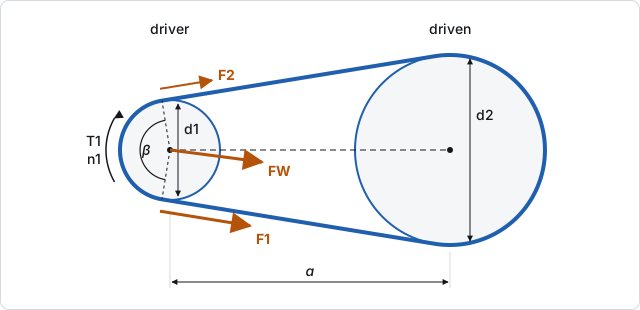
The effective force on the driver is . With the centre distance a, the strands leave the pulleys at , and the small pulley is wrapped over .
A friction belt holds while . With fixed centres the strands share the pretension F₀: and . The least pretension that does not slip is
A timing belt's least pretension is Fc + Ft/2, which keeps its slack strand taut. A chain's slack strand carries only Fc.
The shaft load is the vector sum of F₁ − Fc and F₂ − Fc along the two strands. It points towards the other pulley, off the centre line towards the tight strand (the strand the driver winds on). The driven pulley delivers T·i·η.
Torque on both shafts
Both pulleys turn the same way, so the torques on the two shafts have opposite signs. Power enters the driver shaft as +T and leaves the driven shaft as −T·i·η.
The easy way is to let a load balance each shaft. In the shaft module, select the load where power enters or leaves (the motor, the fan, the output coupling) and tick Takes the torque that balances the shaft (e.g. the output coupling). Its Torque (balances the shaft) field then shows the value it took. The shafts stay balanced when you change the ratio, the efficiency or the speed. One such load per shaft is allowed.
In the V-belt fan drive template, the motor rotor load takes 50 N·m on the motor shaft, and the fan impeller takes −95 N·m on the fan shaft (50 N·m × 2 × 0.95).
Results
The results column shows the checks and two key results:
- Shaft load (kN), with the effective force and the load direction in degrees about +x from +y.
- Output: the driven torque, with the driven speed and the ratio.
The Details card adds Belt speed, Tight / slack strand, Pretension (least), Wrap angle, Centrifugal tension, e^(μ′β) / F₁′/F₂′ (the friction limit and the tension ratio used), Polygon effect (chains), Power and Efficiency / loss. The drive's loss is also part of the project's power loss.
The template (Ø125 → Ø250 mm V-belt, 50 N·m at 1450 rpm, a = 500 mm, defaults otherwise) gives:
| Result | Value |
|---|---|
| Ratio, output | 2, 95 N·m at 725 rpm |
| Effective force Ft | 800 N |
| Wrap angle | 165.6° |
| e^(μ′β) | 14.35 |
| Tight / slack strand | 859.9 N / 59.92 N |
| Least pretension | 459.9 N |
| Shaft load | 918.1 N at 6.253° |
| Belt speed | 9.49 m/s |
| Loss | 379.6 W of 7.592 kW |
The same drive with the tension factor model gives 1600 N along the centre line, about 1.7 times the strand model's load at the least pretension.
The slip check
The check drives.<id>.slip (timing belts: drives.<id>.slackStrand) compares the pretension with the least it needs. Chains have no slip check.
In the template, a pretension of 400 N fails: the drive needs 460 N to transmit 800 N. With 600 N and a belt mass of 0.12 kg/m it passes: the centrifugal tension is 10.81 N, the least pretension rises to 470.7 N, the strands carry 1000 N and 200 N, and the shaft load grows to 1173 N.
To fix a failing slip check:
- Raise Pretension at standstill. This also raises the shaft load and the bearing loads.
- Increase the wrap angle: a longer centre distance, or a smaller ratio.
- Lower Ft with a larger driving pulley.
- For a V-belt, check Groove angle and Friction coefficient μ against the belt maker's data.
Chains
A roller chain with pitch 12.7 mm, 19 and 38 teeth and 0.7 kg/m in place of the template's belt gives Ft 1296 N on the 77 mm pitch circle, a wrap angle of 171.2°, a shaft load of 1296 N and a speed variation of 1.364 % from the polygon effect, 1 − cos(180°/z₁). More teeth on the small sprocket reduce it.
Drive view
The Drive view card above the details has two tabs:
- 2D draws the drive seen along +x (y up, z right): both pulleys or sprockets at their pitch diameters, the centre distance at the drive's direction, and the belt or chain round them. The tight strand is drawn heavier. Labels give the wrap angles β₁ and β₂, the pulley sizes and speeds, and the centre distance. Amber arrows show the strand forces F₁ and F₂ on the driver and the shaft load on each shaft, all at one scale. A sprocket with teeth and a pitch shows its teeth, and a note gives the chain's polygon effect.
- 3D shows the same drive with grooved pulleys, a toothed belt's pulleys or sprockets, and the belt or chain. Point at it (or move the keyboard focus to it) and the drive turns for a moment. Drag to turn the view, scroll to zoom.
With the tension factor model the engine computes no strand forces. The view then estimates them from and , marks them ≈, and says so in a note. Without a centre distance the view draws the pulleys 1.5 × (r₁ + r₂) apart, and the wrap angles shown are those of that drawing.
The 3D tab needs WebGL. Where the browser has none, the view stays on the 2D tab and says why. With reduced motion set in the system, nothing moves.
Standards and scope
- The strand model is the classical Euler–Eytelwein capstan relation with centrifugal tension. No belt or chain standard is applied.
- Not assessed: the belt section and number of belts, belt power ratings, belt or chain life, chain wear, tooth jump of timing belts and sprocket strength. Use the belt or chain maker's data for these.
- The centre distance is fixed; tensioner pulleys and idlers are not modelled.
- The efficiency is a constant per kind, not computed from the load.
From the command line
axm new fan.axm.json --template belt-drive
axm drive update fan.axm.json D1 --patch '{"pretension":600,"beltMass":0.12}'
axm solve fan.axm.json
axm guide gearboxes lists every field of a drive.