Planetary sets
Rate a simple planetary stage of sun, planets and ring by ISO 6336 per mesh: ratio, load sharing, planet speed and pin load, assembly and neighbour checks, and the face load factor from a deforming carrier.
- ISO 6336-1:2006
- ISO 6336-2:2019
- ISO 6336-3:2019
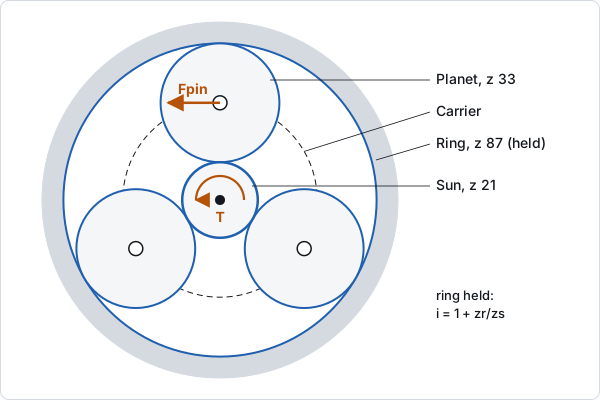
The Planetary module rates a simple planetary stage: one sun, equally spaced planets and a ring. Each planet's sun mesh (external) and ring mesh (internal) is rated as an ISO 6336 gear pair at the speeds relative to the carrier. The module also gives the ratio and output, the planet speed and pin load, and checks that the set can be assembled. A carrier model turns the deformation of pins and cheeks into a face load factor.
Inputs
Choose + Planetary above the list (or Add planetary in an empty module). The inspector groups:
Gears
| Label | Unit | Notes |
|---|---|---|
| Sun teeth, Planet teeth, Planets | The planet count must allow equal spacing. | |
| Ring teeth | Empty: zs + 2·zp. | |
| Normal module, Face width | mm | Common to all meshes. |
| Helix angle, Pressure angle | ° | 0 and 20 by default. |
Profile shifts and ring tip
Sun profile shift x, Planet profile shift x, Ring profile shift x and Ring tip diameter. A ring with a full addendum meets the planets' root fillets unless they are shifted, so when the tip diameter is empty the ring's tip is shortened only as far as needed to meet the planets at their form circle (Ø255.53 mm for the 21/33/87 × m3 template). A given value overrides this.
Drive
- Held member: Ring (sun → carrier), the usual reduction with , or Carrier (star, sun → ring).
- Sun torque (N·m) and Sun speed (rpm).
- Load sharing Kγ: empty takes the value by the number of planets (1.1 for three); enter a measured or required value otherwise.
- Application factor KA and Life (h).
- Planet bearing: a bearing from the bearing module that carries one planet. It then gets the pin load at the planet's speed relative to the carrier, with its outer ring turning.
Carrier
Leave Planet pin diameter empty and the carrier is rigid; KHβ is then the fixed 1.15. With a pin the model tilts each planet over the face width and KHβ follows by ISO 6336-1 method C on both meshes:
- Planet pin diameter and Pin length (between the cheeks, or cheek to planet middle).
- One cheek (pins overhung): an overhung pin bends (tilt ); a pin held in two cheeks does not.
- Wind-up stiffness between the cheeks (N·mm/rad), or the cheek geometry (Cheek outside diameter (for the carrier by FE), Cheek bore, Cheek thickness, Web angle round the axis (each, between the planets)), from which a 3D finite element model of the two cheeks and their webs gives the wind-up stiffness.
Materials and requirements
σHlim and σFlim for sun, planet and ring, Min pitting safety (1.0) and Min root safety (1.4).
Results
The view card draws the set along its axis and shows Safeties per gear: pitting and tooth root for Sun, Planet (sun), Planet (ring) and Ring. A planet's teeth bend both ways, so its root safety counts at 70 % (ISO 6336-3 reverse bending). The key figures are Lowest pitting safety and Ratio; Details lists the planet speed relative to the carrier, the planet pin load, the ring tip diameter, Kγ and, with a carrier, the planet tilt and mesh misalignment.
In 3D the sun, the planets on the carrier's pins and the ring are built from their real tooth counts, module and face width at the result's centre distance; hovering turns the sun once and the planets roll round it at the real ratio (the carrier turning with the ring held, the ring turning back with the carrier held). The 2D and 3D tabs above the drawing switch to a 3D model; the choice is kept for the module. In 3D, drag to orbit and scroll to zoom; the model stands still and plays its motion once when the pointer moves onto it or it gets the keyboard focus (never with reduced motion). Without WebGL the drawing stays, with a note.
The Planetary stage template (sun 21, three planets 33, ring 87 × m3, b 40 mm, 300 N·m at 1500 rpm, KA 1.25, ring held) gives:
| Result | Value |
|---|---|
| Ratio | 5.143, output 1543 N·m at 291.7 rpm |
| Planet speed relative to the carrier | 768.9 rpm |
| Load sharing Kγ | 1.1 |
| Planet pin load | 6987 N (centrifugal force 182.6 N included) |
| Sun–planet | σH 849 MPa, SH 1.741 / 1.820, SF 6.782 / 4.966 |
| Planet–ring | σH 467.5 MPa, SH 3.311 / 2.346, SF 4.256 / 5.304 |
The sun mesh governs pitting. Load cycles count relative to the carrier: a sun or ring tooth meets every planet once per relative revolution, a planet tooth meets each mesh once.
Pin load and planet bearing
The pin load is the vector sum of both meshes' tooth forces, multiplied by Kγ, and the planet's centrifugal force. For the standard tooth counts without shifts it reduces to . Link a Planet bearing to rate the planet's bearing under this load.
The carrier matters
The same template with an overhung pin of Ø25 mm and 30 mm length (One cheek (pins overhung)) deflects 15.6 µm at the planet, tilting it by 2.68′. The 29.6 µm mesh misalignment raises KHβ to 3.52 on the sun mesh and 3.95 on the ring mesh, and the lowest pitting safety drops from 1.741 to 1.038. A pin held in two cheeks, a thicker or shorter pin and a stiffer carrier are the levers.
When a set is refused
The solve checks assembly, coaxiality and neighbours before rating:
- Five planets in the template:
planets cannot be equally spaced: (z_s + z_r)/N = 108/5 is not whole. Choose a planet count that divides zs + zr, or change the tooth counts. - Six planets:
6 planets of tip Ø105.0 mm collide on the 162.0 mm circle; use fewer or smaller planets. - Ring mesh errors name Ring tip diameter, the shifts or the tooth counts, the set's own inputs.
Fixing a failing check
- Pitting on the sun mesh: wider face, larger module, more planets (if they fit), a lower Kγ (better load sharing, for example a floating sun) or a stiffer carrier.
- Planet root: the 70 % reverse bending factor makes the planet the weak tooth; a positive planet shift or a larger module helps.
- Ring: a nitrided or through-hardened ring has a lower σHlim than the case-hardened sun; check its pitting safety on its own.
Standards and scope
Each mesh is rated by ISO 6336 as described for gear pairs, the ring as an internal gear whose root comes from its shaper cutter (as many teeth as the planet). Kγ by the number of planets follows the usual industry values unless given. The carrier model covers pin bending and the cheeks' wind-up; it does not model the carrier's radial flexibility, planet position errors or a floating sun. Scuffing, load spectra and the loaded tooth contact are not available for planetary sets; for a detailed look at one mesh, rate it as a gear pair with the carrier's misalignment entered as Mesh misalignment fβ.
From the command line
axm new stage.axm.json --template planetary-stage
axm planetary update stage.axm.json PG1 --patch '{"carrier":{"pinDiameter":25,"pinLength":30,"singleWalled":true}}'
axm solve stage.axm.json
Related
- Gear pairs
- ISO 6336 gear rating
- Bearings for the planet bearing
- Open the planetary stage example