Bearing static safety and static load rating (ISO 76)
A bearing that stands still, turns slowly or takes a heavy shock fails by permanent dents in its raceways before it fails by fatigue. ISO 76 limits the contact stress at the most heavily loaded element: 4600 MPa for self-aligning ball bearings, 4200 MPa for other ball bearings and 4000 MPa for roller bearings. The static load rating C0 is the load that reaches that stress, and the static safety s0 says how far the actual load is below it.
Axomek applies the definition directly. It finds C0 from Hertz contact at the bearing’s own groove radii, and s0 from the largest contact stress of the solved load distribution, so clearance, tilt and preload count.
- ISO 76:2006
- DIN ISO 76:2009
What Axomek calculates
You enter
- Bearing type and internal geometry: element diameter and number, pitch diameter, contact angle, groove radii or roller length
- Radial and axial clearance, and the materials (steel is rated with E = 207 000 MPa and ν = 0.3)
- Loads and moments, or the loads from a shaft support, and the inner ring tilt
- Optionally a duty cycle with a peak load case
- Minimum static safety s0
It calculates
- Basic static load rating C0 and the element load Q0 at the stress limit
- Largest contact stress pmax, with the element and ring where it occurs
- Static safety s0, in the worst load case of a duty cycle
- Pass or fail against the minimum static safety
Method and standards
- Hertz point or line contact at the actual groove radii gives the element load Q0 at which the most heavily loaded contact, inner or outer, reaches the ISO 76 stress limit
- C0r = 0.2·i·Z·Q0·cos α for radial bearings (the standard’s 5·Fr/(Z·cos α) basis turned round), C0a = Z·Q0·sin α for thrust bearings
- With the standard’s constants this reproduces f0 of Table 1 to half a printed digit and the constants 44 and 220 of Eq. (7) and (11) within 0.5 % (
axm verify) - s0 = (σlim/pmax)³ for point contact and (σlim/pmax)² for line contact, with pmax from the solved internal load distribution instead of P0 = X0·Fr + Y0·Fa
Limits
- Judges the contacts only: ring, cage and housing strength and the fit are not part of it
- Truncation of the contact ellipse at the groove edge (ISO 76, Clause 1) is not checked
- σlim and C0 are not lowered for a ring hardness below 58 HRC
- Grooves tighter than 0.52/0.53·Dw raise C0, which ISO 76 does not credit
- Hybrid bearings keep their own moduli; ISO 20056 was not available
Worked example
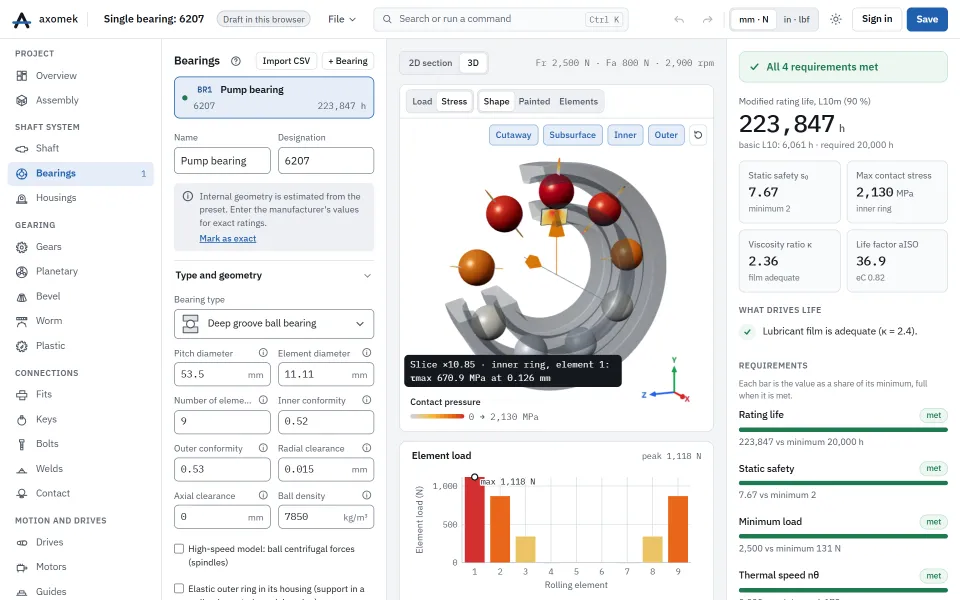
The 6207 example: a deep groove ball bearing (nine 11.11 mm balls on Dpw 53.5 mm, grooves 0.52/0.53·Dw, radial clearance 0.015 mm) under Fr = 2500 N and Fa = 800 N, with a required static safety of 2.
| Result | Value |
|---|---|
| Static load rating C0 | 15,298 N |
| Element load Q0 at 4200 MPa | 8,499 N |
| Largest contact stress pmax | 2,130 MPa |
| Ring with the largest stress | inner |
| Static safety s0 | 7.67 |
| Minimum static safety | 2.0 |
s0 is the factor by which the most loaded ball’s load could grow before its contact reaches 4200 MPa. It comes out higher than the classical C0/P0, as the axial load turns the balls and shares the radial load over more of them than ISO 76 assumes.
The numbers come from the engine: the same commands, run with the axm command line, give them.
The same with the axm command line
axm new ex.axm.json --template bearing-6207
axm solve ex.axm.json --detail --jsonQuestions
What static safety do I need?
ISO 76, Clause 9, gives experience-based minimum values: for ball bearings from about 1 for smooth running to 2 where quiet running and accuracy matter, roller bearings from about 1.5 to 3, and more for shock loads of unknown size.
Why does s0 differ from C0/P0?
C0/P0 assumes the load distribution of the standard. Axomek uses the largest contact stress of the solved distribution, which includes clearance, contact angle change, tilt and preload; under the standard’s load distribution the two are equal.