Hertzian contact stress calculator
When a ball presses into a groove or a roller onto a raceway, the whole load passes through a contact a few tenths of a millimetre wide. The pressure there reaches thousands of MPa, and the largest shear stress lies some way below the surface, where rolling contact fatigue starts.
Axomek rates one contact between two bodies on their own: spheres, cylinders, planes, grooves, tori, crowned rollers or any principal radii, at any angle between them. It solves the contact ellipse with exact elliptic integrals, slices line contacts into laminae like an ISO/TS 16281 roller, and evaluates the full stress field below the surface, with sliding traction if you give one.
- ISO/TS 16281:2008
- ISO 76:2006
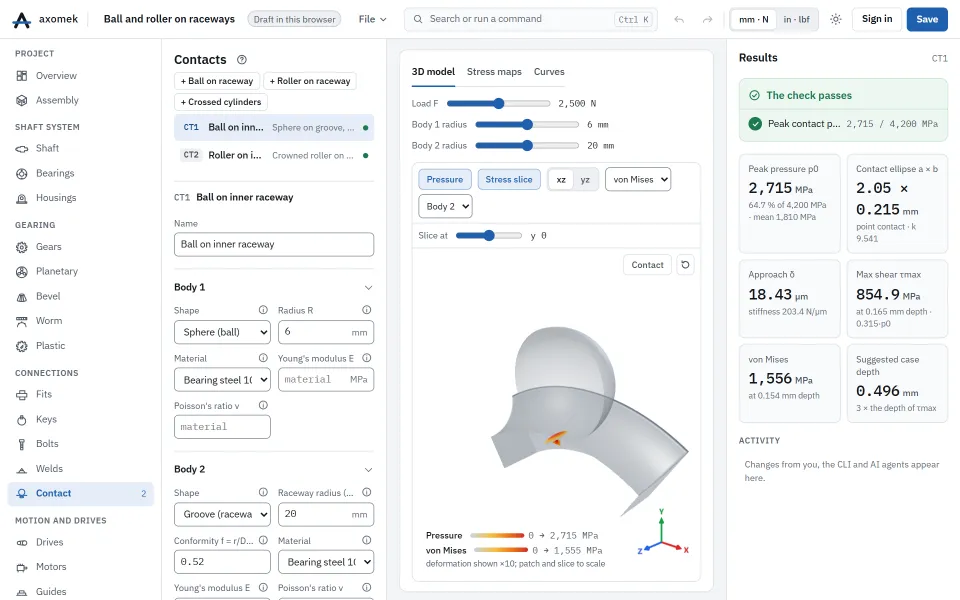
What Axomek calculates
You enter
- Shape of each body: sphere, cylinder, plane, groove with its conformity, torus, crowned roller or general radii Rx, Ry
- Material of each body (bearing steel, Si3N4 ceramic, stainless steel, tungsten carbide, grey iron, tin bronze, aluminium) or your own E and ν
- Normal load and the angle between the principal planes
- For line contacts: laminae, tilt of the axes and the edge stress concentration of ISO/TS 16281
- Traction coefficient μ for sliding and its direction
- Permissible pressure and an optional permissible τmax below the surface
It calculates
- Contact ellipse a × b, or half-width and length of a line contact, with the load per lamina
- Peak pressure p0 and mean pressure
- Approach of the bodies and contact stiffness
- Largest shear stress τmax, von Mises stress and orthogonal shear stress below the surface, each with its depth
- Stress maps across and along the contact, stresses down the axis, and curves of pressure, ellipse and approach against load
- Suggested case depth of three times the depth of τmax
Method and standards
- Relative curvature from the sum of the two bodies’ curvature tensors at any angle between their principal planes
- Point contact after Hertz: the ellipticity solved from the curvature difference with the complete elliptic integrals computed exactly, then a, b, p0 and the approach
- Line contact sliced into laminae as ISO/TS 16281 slices a roller (Eq. 35 to 37), with crown, tilt and the optional edge stress concentration of Eq. 60
- Stresses below a line from McEwen’s plane-strain solution, with traction from the Smith–Liu solution
- Stresses below an ellipse from Boussinesq’s and Cerruti’s potentials of the ellipsoidal pressure, integrated numerically
- Peak pressure checked against 4200 MPa (point) or 4000 MPa (line), the values ISO 76 rates bearings with, or your own limit;
axm verifychecks the contacts against Hertz’s closed forms and the stresses below them against the classical peaks below circular and line contacts
Limits
- Elastic, smooth bodies; plastic deformation and roughness are not modelled
- Residual stresses from hardening are not included
- With traction on unlike materials the coupling of traction and pressure is left out; a note says so when it matters
- A point contact longer than a finite cylinder it lies on gets a warning, not an edge pressure
- The case depth factor of 3 is a rule of thumb, not a standard
Worked example
The ball and roller on raceways template, contact CT1: a 12 mm ball (radius 6 mm) pressed into an inner groove of radius 20 mm with a conformity of 0.52, both bearing steel, with 2500 N.
| Result | Value |
|---|---|
| Peak pressure p0 (permissible 4200 MPa) | 2,715 MPa |
| Semi-major axis a | 2.048 mm |
| Semi-minor axis b | 0.215 mm |
| Approach δ | 18.43 µm |
| Largest shear stress τmax | 854.9 MPa |
| Depth of τmax | 0.165 mm |
| von Mises stress below the surface | 1,556 MPa |
| Suggested case depth | 0.496 mm |
The largest shear stress lies below the surface, not at it; a case-hardened raceway should reach about three times that depth.
The numbers come from the engine: the same commands, run with the axm command line, give them.
The same with the axm command line
axm new ex.axm.json --template hertz-contacts
axm solve ex.axm.json --jsonQuestions
Does it give the same result as the Bearings module?
For a ball in its groove, yes: both solve the same Hertz contact, and axm verify compares the two.The Bearings module solves every rolling element of a bearing; the Contact module rates one contact on its own.