Bearing life calculation (ISO 281)
The rating life tells you how long a rolling bearing runs before the first sign of material fatigue, reached or exceeded by 90 % of a group of identical bearings. The modified rating life corrects it for lubrication, contamination, the fatigue limit of the steel and, if you ask for it, a higher reliability.
Axomek rates every bearing, on its own or on a shaft support, to ISO 281:2007. It computes the life from the actual loads on the rolling elements (ISO/TS 16281) rather than from X and Y factors, combines a duty cycle by Palmgren–Miner and gives the system life of all bearings on a shaft.
- ISO 281:2007
- ISO/TR 1281-1:2008
- ISO/TR 1281-2:2008
- ISO/TS 16281:2008
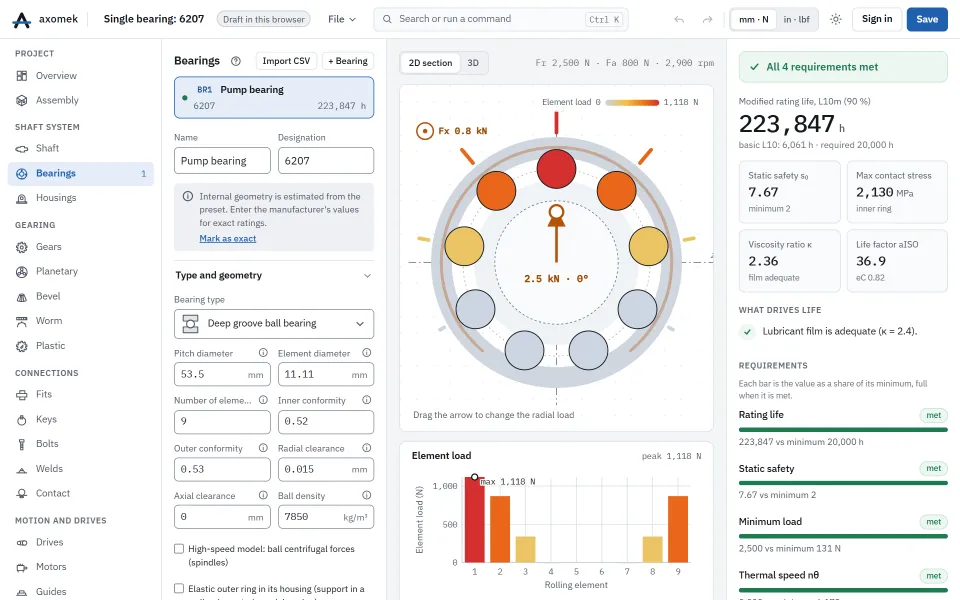
What Axomek calculates
You enter
- Bearing type and internal geometry (pitch diameter, element diameter and number, groove radii, contact angle, clearance), or a catalogue preset
- Radial and axial loads and moments, or the loads from a shaft support
- Speed and operating temperature, or a heat balance
- Lubricant viscosity at 40 °C and 100 °C, and lubrication and cleanliness (the 14 cases of ISO 281 Annex A)
- Reliability, L10 to L0.05 (90 % to 99.95 %), and the minimum life
- Optionally a duty cycle of load cases with shares, load factors, speeds and temperatures
It calculates
- Dynamic load rating C and fatigue load limit Cu
- Reference equivalent load Pref from the element loads, and ISO 281’s P = X·Fr + Y·Fa for comparison
- Basic rating life L10 in revolutions and hours
- Viscosity ratio κ, contamination factor eC, life modification factor aISO and reliability factor a1
- Modified rating life Lnm, over the duty cycle when one is set, and the system life of the bearings on a shaft
- Pass or fail against the minimum life
Method and standards
- C from Eq. (1), (2) and (13) for radial and Eq. (5) to (8), (17) and (18) for thrust bearings, with fc from the ISO/TR 1281-1 equations at the bearing’s own groove radii (they reproduce Tables 2, 4, 7 and 10 at the tables’ radii)
- L10 = (C/P)p, p = 3 for ball and 10/3 for roller bearings, with P the reference load Pref of ISO/TS 16281
- Lnm = a1·aISO·L10, Eq. (23); a1 from Table 12, aISO from Eq. (31) to (42), at most 50, with κ above 4 taken as 4
- Cu by the advanced method of Annex B.3.2: Hertz contact at 1500 MPa for balls (1250 MPa mean for rollers)
- κ = ν/ν1 by Eq. (27) to (29), with ν from the Walther equation through ν40 and ν100; eC from the equations of Annex A
- System life of several bearings or rows by the Weibull rule, e = 10/9 for ball bearings and 9/8 otherwise
Limits
- Subsurface fatigue only: wear, micropitting, smearing, corrosion, electrical erosion and water in the oil are not covered
- No warning for very heavy loads (P above C0 or 0.5·C); the static safety covers C0
- Grooves tighter than 0.52/0.53·Dw raise C, which ISO 281 does not credit
- Below κ = 0.1, where ISO 281 gives no aISO, the value at κ = 0.1 is used with a warning; there is no setting for EP additives
- Hybrid bearings are computed with their own moduli, not to ISO 20056; ISO 16281:2025 has not been checked against its text
Worked example
The 6207 example: a deep groove ball bearing with estimated internal geometry (Dpw 53.5 mm, nine 11.11 mm balls, grooves 0.52/0.53·Dw, radial clearance 0.015 mm) under Fr = 2500 N and Fa = 800 N at 2900 rpm and 70 °C, with a lubricant of ν40 100 and ν100 11 mm²/s and the cleanliness class “Grease, high cleanliness”. It must reach 20 000 h at 90 % reliability.
| Result | Value |
|---|---|
| Dynamic load rating C | 25,189 N |
| Equivalent load Pref (element loads) | 2,475 N |
| ISO 281 P = X·Fr + Y·Fa, for comparison | 2,756 N |
| Basic rating life L10h | 6,061 h |
| Viscosity ratio κ | 2.36 |
| Contamination factor eC | 0.820 |
| Life modification factor aISO | 36.9 |
| Modified rating life L10mh | 223,847 h |
The basic life alone would fail the 20 000 h requirement; the thick oil film (κ) and the clean lubricant (eC) raise aISO, and the modified life passes.
The numbers come from the engine: the same commands, run with the axm command line, give them.
The same with the axm command line
axm new ex.axm.json --template bearing-6207
axm solve ex.axm.json --detail --jsonQuestions
Why is the equivalent load not X·Fr + Y·Fa?
Axomek solves the actual load on every rolling element, with clearance and contact angle change, and takes the reference load Pref of ISO/TS 16281 that gives the same life in ISO 281’s life equation. ISO 281’s own P from X and Y is reported alongside for comparison; the lives do not use it.
Why is my C lower than the catalogue value?
C here is an ISO 281 rating at the bearing’s internal geometry; a preset’s geometry is estimated. Bearing makers often publish ratings 10–25 % above ISO 281. For a catalogue comparison enter the maker’s pitch diameter, element diameter and number.