Rating life (ISO 281)
Basic and modified rating life of rolling bearings after ISO 281:2007: load ratings, the reliability factor a1, the life modification factor aISO with κ, eC and Cu, the system life, and how the app applies them.
- ISO 281:2007
- ISO/TR 1281-1:2008
- ISO/TR 1281-2:2008
- ISO/TS 16281:2008
What the rating life means
ISO 281 defines the life of a bearing as the revolutions one ring makes relative to the other before the first sign of material fatigue (Clause 3). Fatigue lives scatter widely, so the standard works with a rating life, reached or exceeded by a stated percentage of a large group of identical bearings. The basic rating life L10 holds for 90 % reliability, good-quality steel and conventional conditions. The modified rating life Lnm corrects it for another reliability, lubrication, contamination and the fatigue limit of the steel (Clause 9).
All numbers on this page come from the bearing-6207 template: a 6207 deep groove ball bearing with estimated internal geometry (Dpw 53.5 mm, Dw 11.11 mm, 9 balls, groove radii 0.52/0.53·Dw), Fr = 2 500 N, Fa = 800 N, 2 900 rpm, an oil of ν40 = 100 and ν100 = 11 mm²/s at 70 °C.
Basic dynamic load rating C
The basic dynamic load rating is the load a bearing carries for one million revolutions at 90 % reliability. For radial ball bearings:
for Dw ≤ 25.4 mm (Eq. (1)), with a factor 3.647 and above that (Eq. (2)).
Radial roller bearings follow Eq. (13),
thrust bearings use Eq. (5) to (8) and (17), (18), and bearings with several rows of thrust rollers are combined by Eq. (19). Here i is the number of rows, Z the elements per row, α the nominal contact angle, Lwe and Dwe the effective roller length and diameter. The factor bm (1.3 for radial ball bearings, Table 1; Tables 6 and 9 for rollers) reflects modern steel quality.
fc at the actual groove radii
The geometry factor fc depends on and on the groove radii. ISO 281 tabulates it (Tables 2, 4, 7 and 10); ISO/TR 1281-1 gives the equations behind them: Eq. (15) for radial ball bearings and Eq. (20), (25), (35), (39) and (43) for the other types. The tables are those equations evaluated at fixed radii (ISO/TR 1281-1, Table 1): 0.52·Dw on both rings of radial ball bearings, 0.53·Dw on the inner ring of self-aligning ball bearings and 0.535·Dw for thrust ball bearings. ISO 281, 5.1.1 lets the table stand for grooves up to 0.52·Dw (inner) and 0.53·Dw (outer), asks for a reduced fc for wider grooves, and gives no credit for tighter ones.
The app evaluates the ISO/TR 1281-1 equation at the bearing's own groove radii (innerConformity, outerConformity). At the tables' radii it reproduces Tables 2, 4, 7 and 10 to half a printed digit (axm verify); the common 0.52/0.53 grooves rate 0.3 % to 9 % below Table 2. For the 6207 template:
| Grooves (inner/outer) | fc | C |
|---|---|---|
| 0.52/0.53·Dw (template) | 58.72 | 25 189 N |
| 0.52/0.52·Dw (table radii) | 59.83 | 25 663 N |
| 0.515/0.525·Dw | 65.37 | 28 040 N |
A ring hardness below 58 HRC reduces C by , a common convention outside ISO 281. Bearing makers often publish ratings 10–25 % above ISO 281; for a catalogue comparison enter the maker's Dpw, Dw and Z.
Basic rating life L10
The life equation is
in millions of revolutions, with p = 3 for ball bearings and p = 10/3 for roller bearings (Eq. (4), (12), (16), (22)).
In hours, with n in rpm. Point contact gives the exponent 3 and line contact 4; ISO 281 uses 10/3 for all roller bearings and adjusts the ratings to compensate (ISO/TR 1281-1, Clause 6).
P is the dynamic equivalent load. ISO 281 obtains it from X and Y factors; the app instead uses the reference load Pref of ISO/TS 16281, computed from the element loads (see Equivalent bearing load). The template gives Pref = 2 474.6 N, so million revolutions, which at 2 900 rpm is 6 061 h.
ISO 281, 5.3.2 (and its counterparts for the other types) warns that the life equation is unproven when P exceeds C0 or 0.5·C, whichever is smaller (plastic deformation), and that very light loads bring other failure modes. The app does not warn about heavy loads (the static safety covers C0); light loads meet the minimum load check (see Bearing friction and thermal speeds).
Reliability factor a1
The modified life equation, Eq. (23), is
a1 converts the 90 % life to a higher reliability. ISO 281, Table 12 lists it from 90 % (L10m, a1 = 1) to 99.95 % (L0.05m). The values come from a three-parameter Weibull distribution with slope 1.5 that approaches a1 = 0.05 for very high reliability (ISO/TR 1281-2, 4.2.3, Eq. (12)):
with S the reliability in %.
Reliability under Requirements (limits.reliability) offers every level of Table 12, L10 to L0.05, and the life check uses the life at that level. The template's modified life is 223 847 h at L10, 55 962 h at L1 (a1 = 0.25) and 17 236 h at L0.05 (a1 = 0.077).
Life modification factor aISO
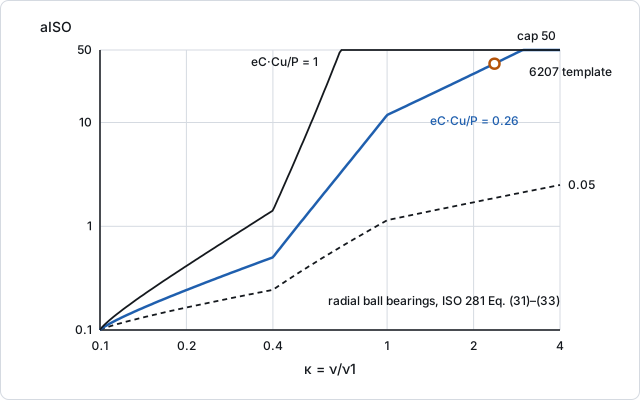
ISO 281, 9.3 relates every influence to the contact stress. Below a fatigue stress limit of about 1 500 MPa a modern steel bearing can in principle run indefinitely; lubrication, contamination and load decide how close it comes. The practical form, Eq. (26), is
given as curves in Figures 3 to 6 and as Eq. (31) to (33) (radial ball), (34) to (36) (radial roller), (37) to (39) (thrust ball) and (40) to (42) (thrust roller). aISO is limited to 50, also when eC·Cu/P exceeds 5, and κ above 4 is taken as 4 (9.3.3.4).
Fatigue load limit Cu
Cu is the load at which the most heavily loaded contact reaches the fatigue stress limit (9.3.2, Annex B). The app uses the advanced method of Annex B.3.2: Hertz contact at the actual groove radii with E = 207 000 MPa and ν = 0.3 finds the element load Qu that gives 1 500 MPa, and for radial ball bearings (Eq. (B.10)), reduced by above Dpw = 100 mm (Eq. (B.11)). For roller bearings Annex B.3.2.1.3 asks for a numerical analysis of the profiled contact; the app uses Hertz line contact at 1 250 MPa, the mean stress that corresponds to a 1 500 MPa peak (ISO/TR 1281-2, 9.2), with Eq. (B.14), (B.15). The outer ring contact of a self-aligning ball bearing may take a 60 % higher limit load (B.3.2.1.2). The template gives Qu = 387 N per ball and Cu = 797 N.
Viscosity ratio κ
(Eq. (27)), where ν is the kinematic viscosity at the operating temperature and ν1 the reference viscosity needed for an adequate film. ν1 depends on speed and pitch diameter: below 1 000 rpm and from 1 000 rpm (Eq. (28), (29); Figure 2). For grease, the base oil viscosity is used (9.3.3.3.3). ISO 281 allows a better κ for proven EP additives (9.3.3.3.4); the app has no setting for this.
The app takes ν from the Walther equation through ν40 and ν100 (see Lubrication and viscosity), as catalogue viscosity charts do. The template has ν = 27.0 mm²/s at 70 °C and ν1 = 11.4 mm²/s, so κ = 2.36.
Contamination factor eC
Particles rolled over leave dents that raise the local stress. Table 13 gives guide values; Annex A gives equations by lubrication method: circulating oil with on-line filters (A.4, Figures A.1 to A.4), oil bath or off-line filtration (A.5, Figures A.5 to A.9) and grease (A.6, Figures A.10 to A.14, chosen by Table A.1). eC grows with κ and with bearing size. Water and other fluids are not covered (9.3.3.2).
The list Lubrication and cleanliness offers the 14 Annex A cases: four ISO 4406 classes of oil with on-line filter, five of oil without one, and five grease conditions from "Grease, high cleanliness" to "Grease, very severe contamination". eC uses the same κ as aISO, limited to 4. The template's class "Grease, high cleanliness" gives eC = 0.820; "Grease, slight to typical contamination" drops the modified life from 223 847 h to 10 223 h.
With and κ = 2.36, Eq. (33) gives aISO = 36.9, and .
Below κ = 0.1
ISO 281 gives no aISO below κ = 0.1 (9.3.3.4). The app then takes aISO and eC at κ = 0.1 and warns. At 30 rpm the template has κ = 0.074, aISO = 0.100 and a modified life of 58 664 h against a basic 585 924 h, with the message "viscosity ratio κ = 0.074 is below 0.1, where ISO 281 gives no life modification factor: aISO is taken at κ = 0.1, and the modified life is optimistic for a bearing without a separating film". A κ that is zero or cannot be computed gives aISO = 0, also with a warning.
Life from the element loads
The app always computes the life from the actual element loads after ISO/TS 16281, with clearance and tilt: (Eq. (32), (33) for balls). For roller bearings, Life factor aISO takes one aISO from Pref (the default) or one per lamina (Eq. (68) to (71)), which gives some 30–45 % shorter modified lives. See Internal load distribution.
System life
Bearings that must all survive form a series system. With Weibull-distributed lives the system life at 90 % reliability is
with e = 10/9 when every bearing is a ball bearing and e = 9/8 otherwise. These slopes match the row exponents in the ratings ( for balls, for rollers). The app applies it to the rows of a double-row bearing and the positions of a bearing set, each with the life of its own element loads, and reports systemLife for two or more bearings (with the reliability factor taken out). An NU 207 preset at 5 000 N radial next to the template's 6207 gives 191 295 h (basic 5 265 h) with e = 9/8. Load cases combine as shown in Equivalent bearing load.
What is not covered
- Failure modes other than subsurface fatigue: wear, micropitting, smearing, corrosion, electrical erosion, water in the oil.
- Very heavy loads (P above C0 or 0.5·C): no warning.
- Truncation of the contact ellipse at the groove edge (ISO 281, Introduction): not reported.
- Hoop stress from tight fits and temperature effects on the steel (ISO/TR 1281-2, Clause 10).
- Hybrid bearings: computed with their own moduli; ISO 20056 was not available.
From the command line
axm new p.axm.json --template bearing-6207
axm solve p.axm.json --detail --json
detail.life holds basicHours, modifiedHours, aIso, contaminationFactor, viscosityRatio and equivalentLoad; detail.ratings holds C, C0 and Cu (dynamic, static, fatigue). lifeDrivers (with or without --detail) says which of κ, eC and aISO limit the life, as "What drives life" does.