Linear guide life calculation (ISO 14728)
A profile rail guide carries a table on one or two rails with several carriages. A load off the centre of the carriage pattern tips the table, so some carriages carry far more than their share, and the most loaded one sets the life of the guide.
Axomek shares the table load over the carriages, finds each carriage’s equivalent load with the moments, and rates the life in kilometres and hours by ISO 14728-1 and the static safety by ISO 14728-2. One project can hold several guides, for example the axes of a gantry.
- ISO 14728-1
- ISO 14728-2
What Axomek calculates
You enter
- Rolling elements (balls or rollers) and the distance the rating refers to (50 km or 100 km)
- Dynamic rating C, static rating C0 and the moment ratings M0x, M0y, M0z of one carriage
- One or two rails, one to four carriages per rail, rail spacing and carriage spacing
- Vertical, lateral and drive force in N, with the load position x, y and height z
- Stroke in mm and double strokes per minute
- Load factor fW, hardness, temperature and contact factors, minimum life and minimum static safety
It calculates
- Roll, pitch and yaw moments on the carriage pattern
- Vertical and lateral load and equivalent load P of each carriage
- Rating life of each carriage in km and h, the shortest life and the system life
- Static safety C0/P of the most loaded carriage
- Mean speed of the table
Method and standards
- The table is rigid on equally stiff carriages: each takes Fz/n plus its share of roll and pitch in proportion to its distance from the centre
- Moments the pattern cannot react (roll on one rail, pitch and yaw with one carriage per rail) go into the carriages through their moment ratings
- Rating life L = (fH·fT·fC/fW·C/P)p × 50 or 100 km, with p = 3 for balls and 10/3 for rollers (ISO 14728-1)
- Life in hours from the distance per hour, 2 × stroke × double strokes × 60
- System life of all carriages with the Weibull slope 10/9; static safety by ISO 14728-2
Limits
- The table is rigid and all carriages equally stiff: elastic tables, carriage preload, rail mounting errors and stiffness sharing are not modelled.
- One load case per guide; a duty cycle or a mean load over the stroke is not computed.
- Lubrication, seals, the drive’s capacity and the rail’s own strength are not assessed.
- Guides are not linked to a shaft; the drive force Fx only adds moments.
Worked example
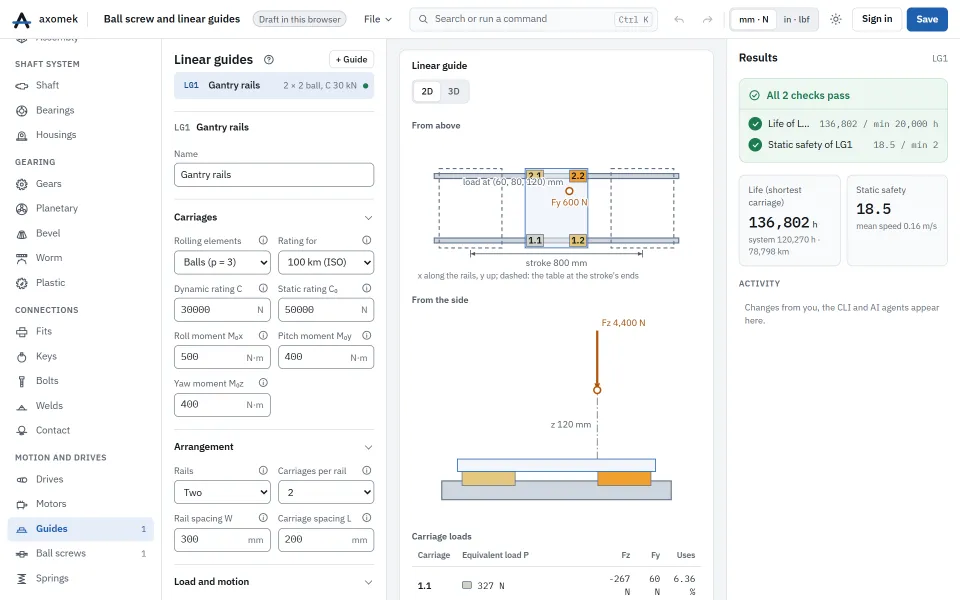
The ball screw and linear guides template: two rails 300 mm apart with two ball carriages per rail 200 mm apart (C 30 000 N for 100 km, C0 50 000 N), loaded with Fz 4400 N and Fy 600 N at x 60, y 80 and z 120 mm, over an 800 mm stroke at 6 double strokes per minute.
| Result | Value |
|---|---|
| Roll moment Mx | 424 N·m |
| Pitch moment My | 264 N·m |
| Vertical load on carriage 2.2 (most loaded) | 2,467 N |
| Equivalent load P on carriage 2.2 | 2,707 N |
| Shortest carriage life (min 20 000 h) | 136,802 h |
| Shortest carriage life in travel | 78,798 km |
| System life of the four carriages | 120,270 h |
| Static safety (min 2) | 18.47 |
The offset load presses rail 2’s carriages and lifts carriage 1.1 slightly; the most loaded carriage sets the life, and both checks pass.
The numbers come from the engine: the same commands, run with the axm command line, give them.
The same with the axm command line
axm new ex.axm.json --template linear-axis
axm solve ex.axm.json --jsonQuestions
Should I enter the 50 km or the 100 km rating?
The one the catalogue gives, with the matching distance. For a ball carriage the 50 km rating is about 1.26 times (21/3) the 100 km rating of the same carriage.