Ball screw calculation (ISO 3408)
A ball screw turns the motor’s rotation into linear travel through balls rolling between the screw shaft and the nut. Its rating life depends on the load spectrum and on the nut’s preload, while the long, slender shaft also limits the speed (critical speed) and the compressive force (buckling).
Axomek rates the screw and nut by ISO 3408-5 over a load spectrum, with a preloaded nut rated as a double nut, and checks the static safety, critical speed, buckling, d·n, efficiency and drive torque. With the ball diameter entered it also rates the nut from its internal geometry, gives the axial rigidity by ISO 3408-4 and solves the nut ball by ball.
- ISO 3408-5:2006
- ISO 3408-4:2006
What Axomek calculates
You enter
- Nominal diameter d0, root diameter d2, lead Ph, dynamic and static ratings Ca and C0a
- Nut preload (0 for a nut with backlash) and the friction of the ball contacts
- Unsupported length, end fixity, which force direction compresses the shaft, and the d·n limit
- Load spectrum: axial force in N, speed in rpm and time share for each step
- Reliability, tolerance grade, ball track hardness and steel melting for the modified ratings
- Optional: ball diameter, contact angle, conformities, loaded turns and circuits for the ball-by-ball model
- Minimum life and minimum static safety
It calculates
- Equivalent load and speed per load direction or nut half
- Rating life in h and travel in km, the nominal life and the modified ratings
- Static safety at the largest force
- Critical speed and buckling load with their allowed values
- d·n, efficiency, lead angle, drive torque and preload torque
- With the ball model: ratings and axial rigidity from the geometry, ball loads, contact pressure, ball static safety and life from the balls
Method and standards
- Equivalent speed and cubic mean load per load direction, weighted by revolutions (ISO 3408-5, clause 7.1, eqs. 23–27)
- A preloaded double nut shares each step between its halves with the operational preload 0.6·Fpr (clause 7.1.3, eqs. 28–34)
- L = (Cam/Fm)³·10⁶ revolutions per direction or nut, combined by eq. 39; modified ratings Cam = Ca·fh·fac·fm (clause 6.2, Tables 1 and 2) and the reliability factor of Table 3
- Critical speed and Euler buckling load of the root diameter beam by the end fixity; the checks allow 80 % of ncr and 50 % of the buckling load
- Axial rigidity by ISO 3408-4, checked against the worked example of its Annex A (
axm verify)
Limits
- The critical speed and buckling load are not part of ISO 3408: they come from a beam of the root diameter with E 206 000 MPa.
- The radial load and tilting moment on the nut act on the ball model only; the ISO ratings assume a purely axial load.
- Thermal growth of the screw, lubrication and wear, the support bearings, motor sizing and fatigue of the shaft or nut body are not covered.
- A vertical axis needs a brake: the screw runs backwards under its load, and the brake is not sized.
Worked example
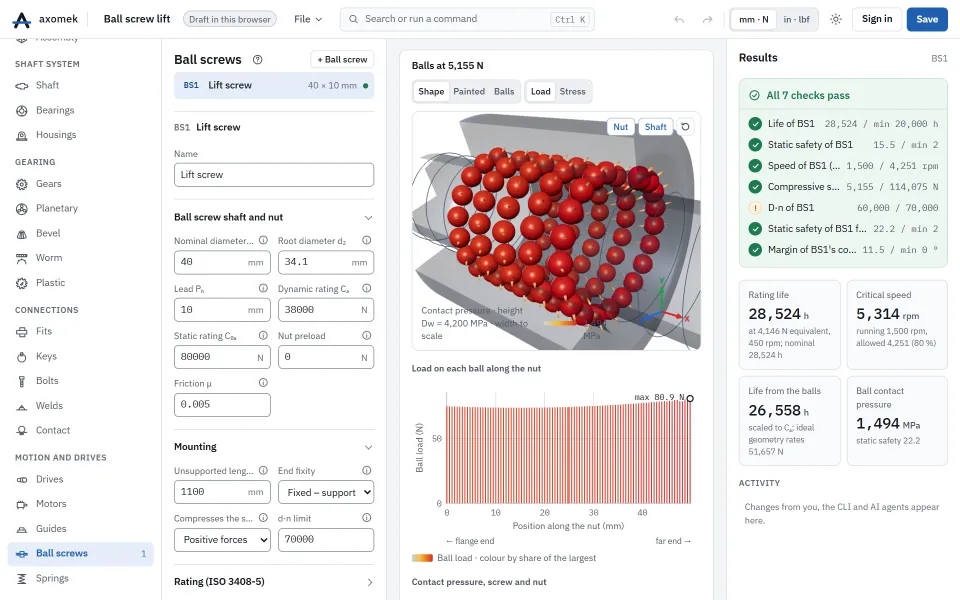
The ball screw lift template: a vertical Ø40 × 10 mm screw (d2 34.1 mm, Ca 38 000 N, C0a 80 000 N), 1100 mm fixed–supported, single nut without preload, lifting 5155 N at 900 rpm for 25 %, holding 4905 N for 60 % and lowering 1766 N at 1500 rpm for 15 % of the time.
| Result | Value |
|---|---|
| Equivalent load Fm | 4,146 N |
| Rating life (min 20 000 h) | 28,524 h |
| Static safety (min 2) | 15.52 |
| Critical speed | 5,314 rpm |
| Allowed speed (80 % of critical) | 4,251 rpm |
| Buckling load | 228,150 N |
| d·n (limit 70 000) | 60,000 |
| Drive torque at the largest force | 8.72 N·m |
All checks pass; d·n is the closest to its limit.
The numbers come from the engine: the same commands, run with the axm command line, give them.
The same with the axm command line
axm new ex.axm.json --template ball-screw-lift
axm solve ex.axm.json --jsonQuestions
Should a ball screw nut be preloaded?
Where the force changes sign or the axis must position without play, yes. Where the force keeps one sign, as the weight on a vertical lift, the balls stay on one flank anyway, and a single nut without preload carries the load on all its balls and gives the longer life.
Can I compare the critical speed with a catalogue chart?
Catalogue charts usually give allowed values already. Compare them with 0.8 × the critical speed and 0.5 × the buckling load shown here, not with the full values.