Bearing housing stiffness (finite elements)
A shaft on rigid supports is stiffer than the same shaft in a real housing. The wall round each bearing seat gives way under the bearing load, and that compliance adds to the bearing’s own: the shaft deflects more, its bearings tilt more and its critical speeds fall.
Axomek solves the housing wall by finite elements, as a plane-stress plate or a 3D solid with a hub and ribs, or from an imported FE mesh or reduced stiffness matrix, and gives each seat’s radial stiffness and, in 3D, its tilt stiffness. A shaft support linked to the housing then has that stiffness in series with the support and its bearing.
What Axomek calculates
You enter
- Wall width, height and thickness, Young’s modulus, Poisson’s ratio and density
- Model: plane-stress plate or 3D solid, and the mesh size
- Hub, bearing seat width and ribs (3D solid)
- Bearing bores: diameter and centre, with further bores in the same wall
- Held edges, rigid or (3D solid) on bolted joints of given stiffness
- Loads on the housing: temperature rise, own weight, speed and point loads
- Or an imported STEP solid, Nastran mesh or reduced stiffness matrix
It calculates
- Seat stiffness, horizontal and vertical, and their harmonic mean, in N/µm
- Tilt stiffness of the seat (3D solid) in kN·m/mrad
- Wall stress in MPa per kN of vertical bearing load
- Seat mass for the critical speeds, and the coupling between seats in one wall
- Seat motion from loads on the housing and the centrifugal growth of a turning part
- On the linked shaft: deflection, bearing loads and critical speeds with the housing’s compliance
Method and standards
- Linear elastic finite elements of the wall, meshed in rings round each bore with spokes to the edges
- The bearing load as a cosine pressure on the loaded half of the seat; seat stiffness as the load over the seat’s mean displacement
- The seat’s vertical stiffness in series with the support in the shaft’s xy plane, the horizontal one in the xz plane, and the tilt stiffness in series with the support’s tilt stiffness
- Each seat’s share of the housing mass by Guyan reduction, for the critical speeds
- Imported STEP solids meshed into quadratic tetrahedra; reduced matrices inverted at the seat nodes
Limits
- Linear elastic only: held edges are rigid or springs, with no gaps, contact or slip.
- The housing has no pass/fail checks of its own; its effect shows in the shaft and bearing checks.
- The coupling between seats is left out of the critical speed modes, which take each seat’s own stiffness and mass.
- A reduced matrix gets no centrifugal growth and cannot carry an elastic outer ring; STEP import runs in the desktop app on Windows only.
Worked example
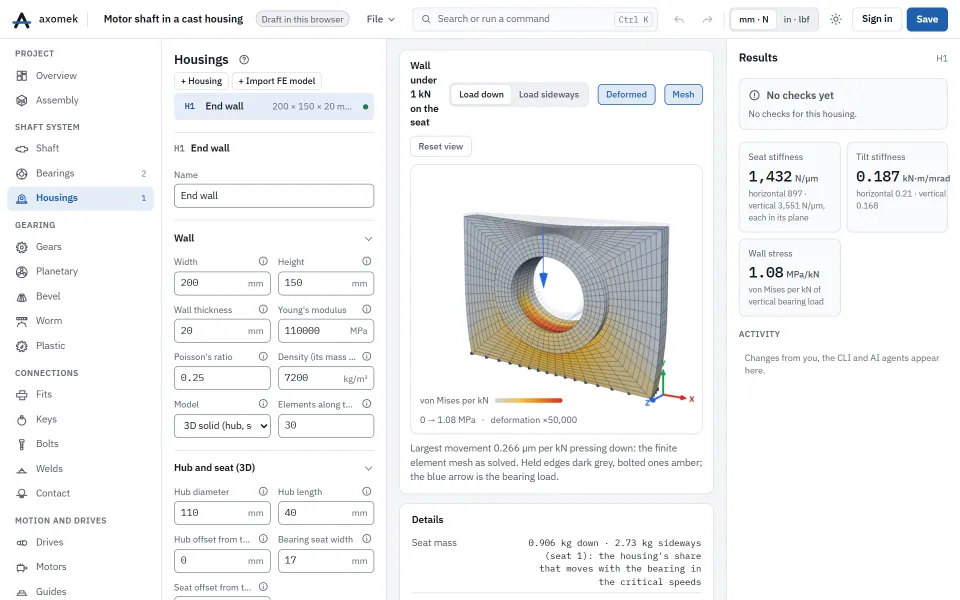
The motor shaft in a cast housing template: an overhung pulley shaft whose two 6207 bearings sit in a grey-iron end wall, 200 × 150 × 20 mm, with a Ø110 × 40 mm hub round a Ø72 mm bore, held at its bottom edge and solved as a 3D solid.
| Result | Value |
|---|---|
| Seat stiffness, horizontal | 896.6 N/µm |
| Seat stiffness, vertical | 3,551 N/µm |
| Mean seat stiffness | 1,432 N/µm |
| Tilt stiffness, horizontal | 0.2103 kN·m/mrad |
| Tilt stiffness, vertical | 0.1683 kN·m/mrad |
| Wall stress per kN of bearing load | 1.078 MPa/kN |
| First critical speed of the shaft | 57,653 rpm |
| Largest shaft deflection (max 50 µm) | 25.0 µm |
The wall, held only at its bottom edge, is much softer sideways than vertically; the housing has no checks of its own, and on rigid seats the first critical speed would be higher.
The numbers come from the engine: the same commands, run with the axm command line, give them.
The same with the axm command line
axm new ex.axm.json --template housing-seats
axm solve ex.axm.json --jsonQuestions
Why is the seat much softer sideways than vertically?
A wall held only at its bottom edge carries a vertical load straight down into the hold, but bends like a cantilever under a horizontal one. Holding more edges, a hub or ribs stiffen it.