Helical spring calculation (EN 13906)
A cylindrical helical spring has to give the right force at two working positions without being overstressed, without its coils clashing, and for a cyclic spring without breaking after millions of strokes. Compression springs can also buckle; extension springs fail in their hooks; torsion springs close in on their arbor as they wind up.
Axomek designs cold coiled springs of round wire: compression springs after EN 13906-1, extension springs after EN 13906-2 and torsion springs after EN 13906-3. It gives the rate and the forces or moments at the two positions, checks the stresses against their limits and, depending on the kind, the solid length, buckling, the hooks, the initial tension and the fatigue safety.
- EN 13906-1:2013
- EN 13906-2
- EN 13906-3
- EN 10270-1
- EN 10270-3
What Axomek calculates
You enter
- Kind: compression, extension or torsion
- Wire diameter d, mean coil diameter D, active and total coils, and the ends of a compression spring
- Wire SL, SM, SH, DM or DH (EN 10270-1) or 1.4310 stainless (EN 10270-3), with Rm, G and E from the tables or your own
- Free length and the working lengths L1 and L2, or the angles α1 and α2 and the legs of a torsion spring
- Extension springs: initial tension and the hook form (German or English loop) with its radii
- Static or cyclic loading, shot peening and the fatigue strength, seating for buckling, bore and arbor diameters
It calculates
- Rate, and the forces (or moments) at both working positions
- Shear stress (bending stress for torsion springs) against the static limit, and the corrected stress for fatigue
- Solid length, sum of least gaps, least working length Ln and the stress at the solid length
- Buckling deflection, natural frequency and the growth of the outside diameter
- Hook bending and torsion stresses, and the initial stress against the range that can be coiled
- Fatigue safety for cyclic compression and torsion springs, and the inside diameter of a torsion spring at α2
Method and standards
- Compression and extension springs after EN 13906-1 clause 9: R = G·d4/(8·D3·n), τ = 8·D·F/(π·d3), corrected τk = k·τ with Bergsträsser’s k for fatigue only
- Least working length Ln = Lc + Sa (9.9), 1.5 times the gaps under cyclic load; buckling with the seating coefficient ν (9.14); natural frequency (9.12)
- Static limits 0.5·Rm (compression), 0.45·Rm (extension), 0.7·Rm (torsion), and 0.56·Rm at the solid length (10.1.1)
- Extension spring hooks at F2 with Wahl’s curved-bar factors: bending against 0.7·Rm, torsion in the bend against 0.45·Rm
- Torsion springs after EN 13906-3: R = E·d4/(3667·D·nk) with the legs in nk, σq = q·32·M/(π·d3)
- Fatigue on a Goodman-type line from the fatigue strength at a lower stress of 0 to 0.5·Rm (compression) or 0.7·Rm (torsion)
Limits
- Cold coiled springs of round wire only: hot coiled, conical, barrel-shaped and disc springs and other wire sections are not covered
- Fatigue uses a Goodman-type line in place of the standard’s fatigue diagrams; the fatigue of extension springs is not assessed
- Relaxation is not computed; the static limits are the usual design values
- Material values at room temperature; the temperature dependence of G and E, transverse loading and impact loading are not applied
- The initial tension range is the spring makers’ preferred range, in place of the standard’s diagram
Worked example
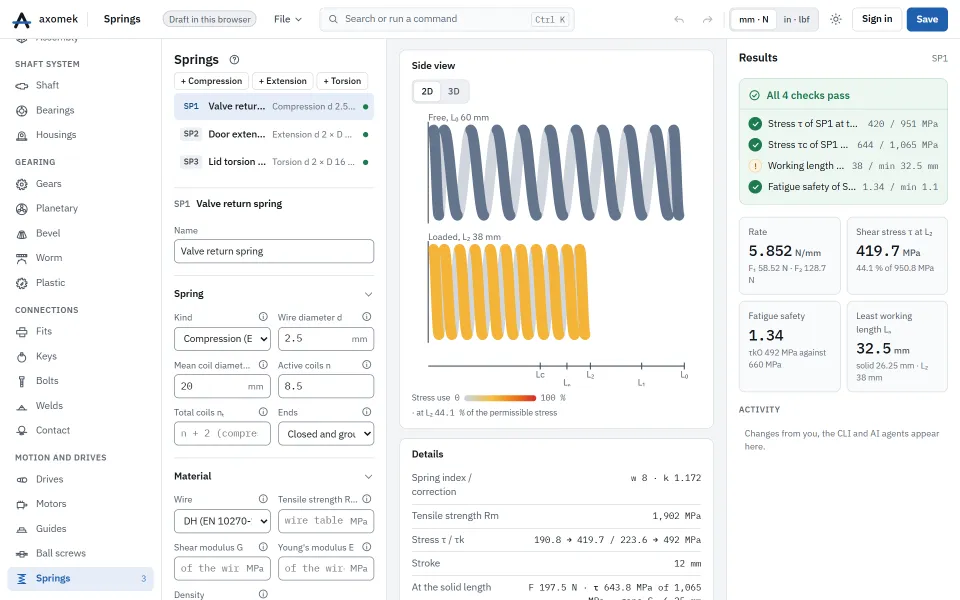
The springs template, spring SP1: a shot-peened valve return spring of DH wire, d 2.5 mm × D 20 mm with 8.5 active coils and closed, ground ends, 60 mm long when free and worked cyclically between 50 mm and 38 mm, both ends fixed.
| Result | Value |
|---|---|
| Rate R | 5.852 N/mm |
| Force F2 at L2 | 128.7 N |
| Shear stress τ at L2 | 419.7 MPa |
| Static limit 0.5·Rm | 950.8 MPa |
| Stress at the solid length τc | 643.8 MPa |
| Least working length Ln (L2 is 38 mm) | 32.5 mm |
| Natural frequency | 266.6 Hz |
| Fatigue safety (minimum 1.1) | 1.34 |
The fatigue strength is estimated as 30 % of Rm for a shot-peened spring; enter a value from the spring maker when you have one.
The numbers come from the engine: the same commands, run with the axm command line, give them.
The same with the axm command line
axm new ex.axm.json --template spring-set
axm solve ex.axm.json --jsonQuestions
Why is the static check made with the uncorrected stress?
EN 13906-1 uses the stress correction factor k for fatigue only (clauses 7 and 10.2). The static check compares the uncorrected τ with its limit.