Weld calculation (EN 1993-1-8, EN 1993-1-9)
A bracket or a lug welded to a plate passes its load through a few thin weld throats. Where the load acts matters as much as how large it is: an offset load twists the weld group, and the most loaded point is usually at the end of a line far from the centroid.
Axomek takes straight weld lines in the face plane with their throats, moves the forces and moments to the centroid of the group, finds σ⊥, τ⊥ and τ∥ at eleven points along every line and checks them after EN 1993-1-8. With a load spectrum it adds the Palmgren–Miner damage sum after EN 1993-1-9, and colours each line by its utilisation.
- EN 1993-1-8:2005
- EN 1993-1-9:2005
- EN 1993-1-1:2005
What Axomek calculates
You enter
- Weld lines by start, end and throat a, each a fillet, full-penetration or partial-penetration butt weld
- Steel grade S235 to S460 (or your own fu, fy and βw), γM2 and γM0
- Method: directional (4.5.3.2) or simplified (4.5.3.3)
- Design forces in and out of the face, their point of action, and added moments
- Optional fatigue spectrum: blocks of stress ranges as multiples of the loads with their cycles
- Detail categories ΔσC and ΔτC (per group or per line) and the partial factors γFf and γMf
It calculates
- Throat area, centroid, second moments and polar moment of the group
- Forces and moments at the centroid
- σ⊥, τ⊥, τ∥ and the equivalent stress at the most loaded point
- Utilisation by the directional and by the simplified method, per point and line
- Design strengths fu/(βw·γM2), 0.9·fu/γM2 and fvw,d
- Fatigue damage sum (normal and shear parts) and how many times the spectrum could be applied
Method and standards
- Each line as a strip of its throat turned into the face plane; section properties of the group from the strips
- Forces moved to the centroid: shear F/A plus Mz·r/Ip in the face plane, σ = Fz/A plus bending about the principal axes across it
- Per line τ∥ along it and, for fillet welds, σ⊥ and τ⊥ on the 45° throat, the worse side taken
- Directional method 4.5.3.2: √(σ⊥2 + 3·(τ⊥2 + τ∥2)) ≤ fu/(βw·γM2) and σ⊥ ≤ 0.9·fu/γM2; simplified method 4.5.3.3 by the force per unit length
- Full-penetration butt welds as the weaker parent plate against fy/γM0; partial-penetration butt welds after 4.7.2
- Fatigue by the nominal stress method of EN 1993-1-9: S–N curves through the detail categories (Table 8.5 details 3 and 8 by default), cut-off at 108 cycles, Palmgren–Miner summation
- Steel strengths of EN 1993-1-1 Table 3.1 for t ≤ 40 mm
Limits
- Weld lines in one plane and straight only: approximate curved or circular welds by short lines
- The side on which the attached part stands is not modelled; the worse 45° throat is taken
- Hot-spot and effective-notch fatigue methods, stainless and aluminium welds, and lamellar tearing are not covered
- There is no weld-specific case in
axm verifyyet
Worked example
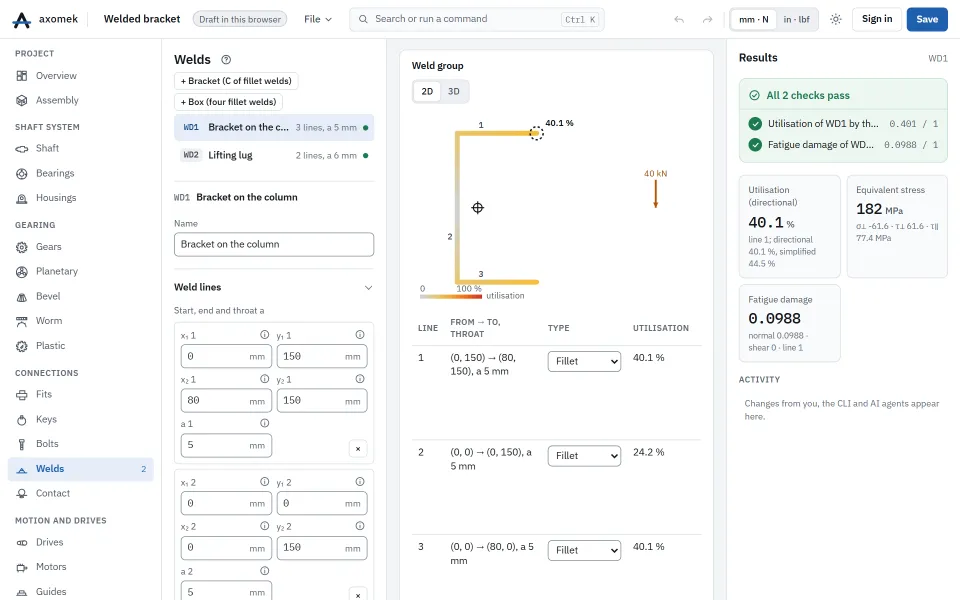
The welded bracket template, group WD1: a bracket on a column flange held by a C of 5 mm fillet welds in S355 (two 80 mm flanges and a 150 mm web line) under Fy = −40 kN at x = 200 mm, y = 75 mm, with a two-block fatigue spectrum of 0.3 × the load for 100 000 cycles and 0.15 × for 2 000 000 cycles.
| Result | Value |
|---|---|
| Throat area of the group | 1,550 mm² |
| Torsion moment Mz at the centroid | -7,174 N·m |
| Equivalent stress at the most loaded point | 182.0 MPa |
| Design strength fu/(βw·γM2) | 453.3 MPa |
| Utilisation, directional method | 40.1 % |
| Utilisation, simplified method | 44.5 % |
| Fatigue damage sum (maximum 1) | 0.099 |
| Times the spectrum could be applied | 10.1 |
The simplified method is the more conservative of the two; both stay well below 100 %, and the spectrum uses a small part of the fatigue life.
The numbers come from the engine: the same commands, run with the axm command line, give them.
The same with the axm command line
axm new ex.axm.json --template welded-bracket
axm solve ex.axm.json --jsonQuestions
Is the throat a the leg length of the fillet?
No. Enter the throat thickness. For an equal-leg fillet weld the throat is about 0.7 times the leg length.
Are the loads design values?
Yes. Enter forces and moments already multiplied by their partial factors.