Press fit and shrink fit calculation (DIN 7190)
An interference fit carries torque and axial force by friction alone. How much it carries depends on the pressure the interference builds between hub and shaft, and that pressure also stresses the hub. DIN 7190-1 treats both parts as thick-walled cylinders, elastic throughout, to answer both questions.
Axomek takes the ISO 286 tolerance classes of the hole and the shaft, takes off the smoothing of the surfaces, and checks the joint at the loosest pair against slipping and at the tightest pair against yielding. It also gives the temperature to shrink the hub on and the speed at which a turning hub comes loose.
- DIN 7190-1:2017
- ISO 286-1:2010
- ISO 286-2:2010
What Axomek calculates
You enter
- Nominal diameter and the ISO 286 classes of hole and shaft
- Hub outside diameter, joint length and the bore of a hollow shaft
- Friction coefficient and the roughness Rz of hub bore and shaft
- Torque and axial force to carry, and the speed when the joint turns
- Assembly temperature and the operating temperatures of shaft and hub
- Hub and shaft materials (steels, ductile and grey iron, aluminium); for a turning hub, optionally a linked housing seat for its centrifugal growth
- Minimum slip and yield safeties
It calculates
- Interference from the limits, the part lost to smoothing and the effective interference
- Contact pressure at the smallest and the largest interference
- Transmissible torque and axial force, and the slip safety
- von Mises stress at the hub bore and in the shaft, with the yield safeties
- Radial and hoop stress through shaft and hub
- Shrink temperature of the hub, the speed at which the joint comes loose, and the capacity left at speed
Method and standards
- Interference from the ISO 286 limit deviations, less the smoothing 0.8·(RzA + RzI)
- Pressure by Lamé’s solution for two thick-walled cylinders in plane stress, with different materials for hub and shaft and a solid or hollow shaft
- Capacity F = pmin·π·d·l·μ and T = F·d/2 at the smallest interference; slip safety against the resultant of the circumferential and axial force
- Hub checked at the bore with DIN 7190’s √3·p/(1 − Q2); the exact plane-stress value is reported next to it
- Operating temperatures change the interference by d·(αshaft·ΔTshaft − αhub·ΔThub); the capacity takes the smaller and the stresses the larger state
- Shrink temperature for the largest interference plus an assembly clearance of 0.001·d; centrifugal loosening from rotating thick-walled cylinders or a linked housing seat’s finite element growth
Limits
- Elastic range only: elastic-plastic press fits are not covered
- Cylindrical hubs of one outside diameter: a linked housing changes only the hub’s centrifugal growth when turning, not the pressure, and conical press fits are not covered
- Fretting, fatigue of the joint and the stress concentration at the hub edge are not assessed; the fit as a notch in the shaft belongs to the shaft strength check
- Only the hub heating temperature is reported, not the cooling of the shaft
Worked example
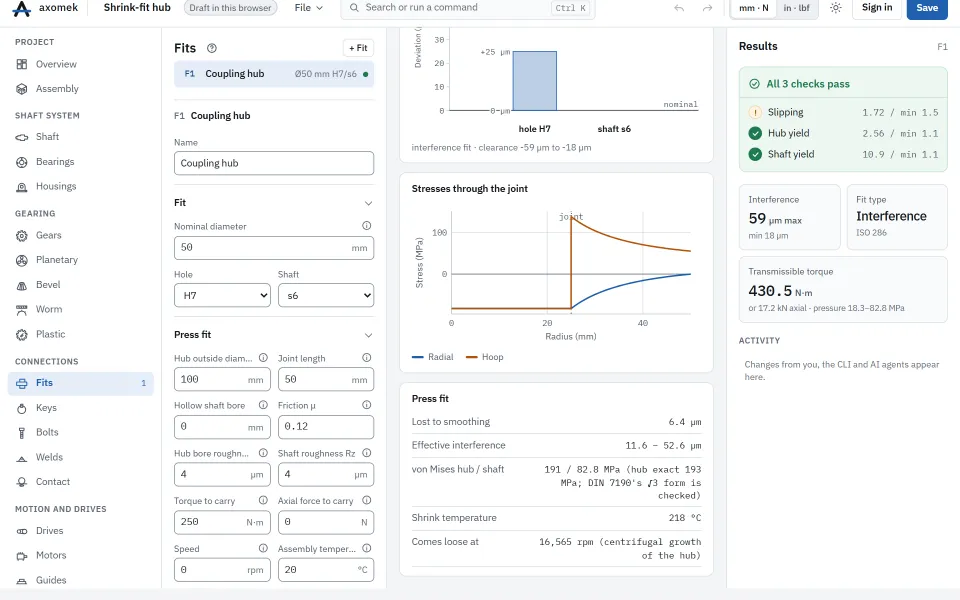
The shrink-fit hub template: a Ø50 mm H7/s6 fit, a C45 +QT hub of Ø100 × 50 mm on a solid 42CrMo4 +QT shaft, Rz 4 µm on both parts, μ 0.12 and 250 N·m to carry.
| Result | Value |
|---|---|
| Contact pressure, smallest interference | 18.3 MPa |
| Contact pressure, largest interference | 82.8 MPa |
| Transmissible torque | 430.5 N·m |
| Slip safety (minimum 1.5) | 1.72 |
| von Mises stress at the hub bore | 191.3 MPa |
| Hub yield safety (minimum 1.1) | 2.56 |
| Shrink temperature of the hub | 218.2 °C |
| Speed at which it comes loose | 16,565 rpm |
The slip safety uses the smallest interference and the yield safeties the largest, so both ends of the tolerance range are checked.
The numbers come from the engine: the same commands, run with the axm command line, give them.
The same with the axm command line
axm new ex.axm.json --template shrink-fit
axm solve ex.axm.json --jsonQuestions
Why is the slip check made at the smallest interference?
The loosest pair of parts the tolerances allow must still carry the torque. The tightest pair sets the stresses, so the hub and shaft yield checks use the largest interference.
Does the joint length change the pressure?
No. The pressure depends on the interference, the diameters and the materials. A longer joint raises the torque capacity in proportion to its length without changing the stresses.